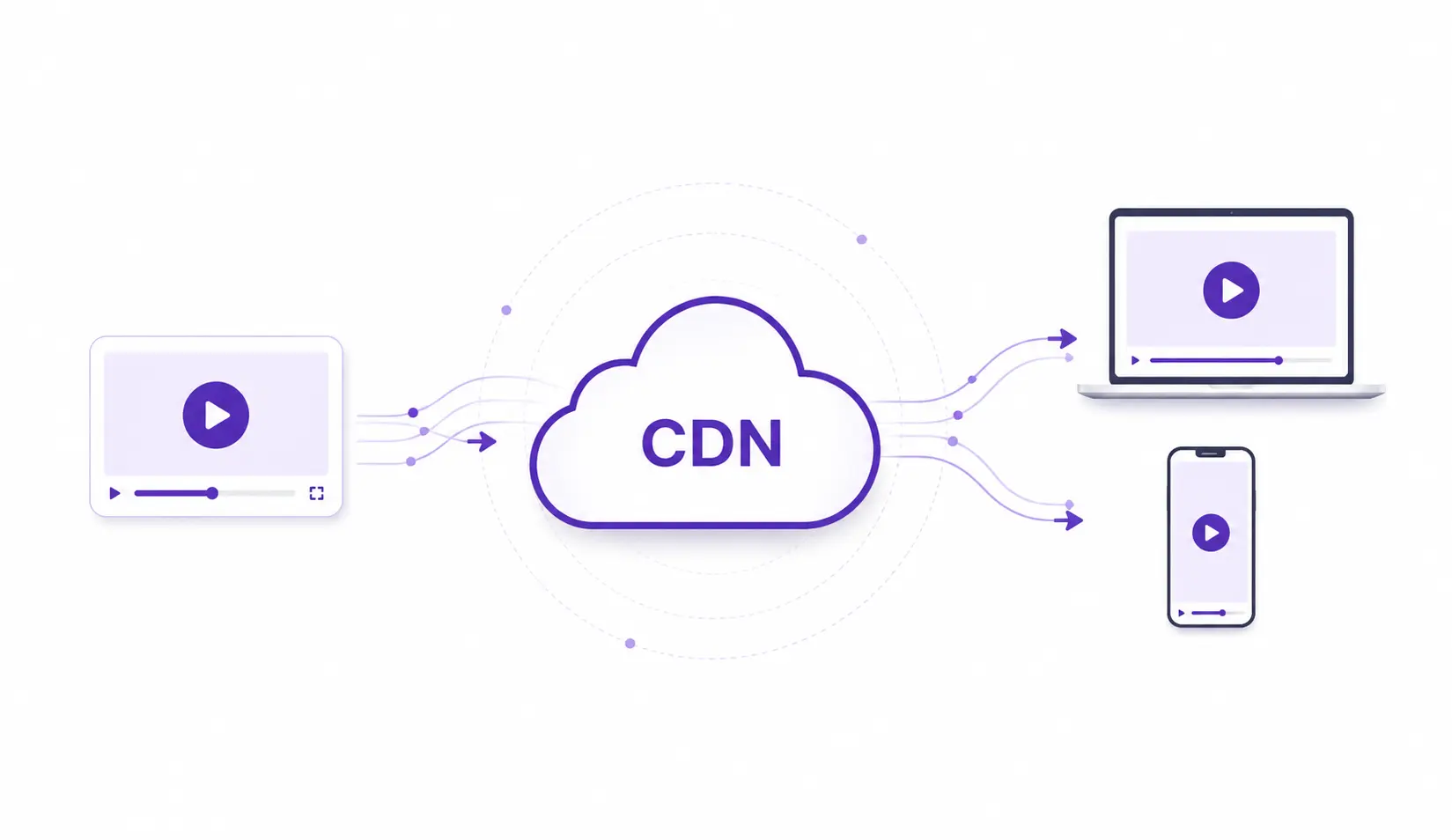
A video CDN, or video content delivery network, is a distributed network of servers designed to deliver live and on-demand video from locations closer to viewers. By caching or routing video through edge servers, it can reduce buffering, improve playback quality, protect origin infrastructure, and support large or unpredictable traffic volumes.
A video CDN applies the core principles of a content delivery network (CDN) to large media files and continuous playback. Instead of making every viewer retrieve video from one origin, it distributes delivery across edge locations closer to audiences.
How Does a Video CDN Work?
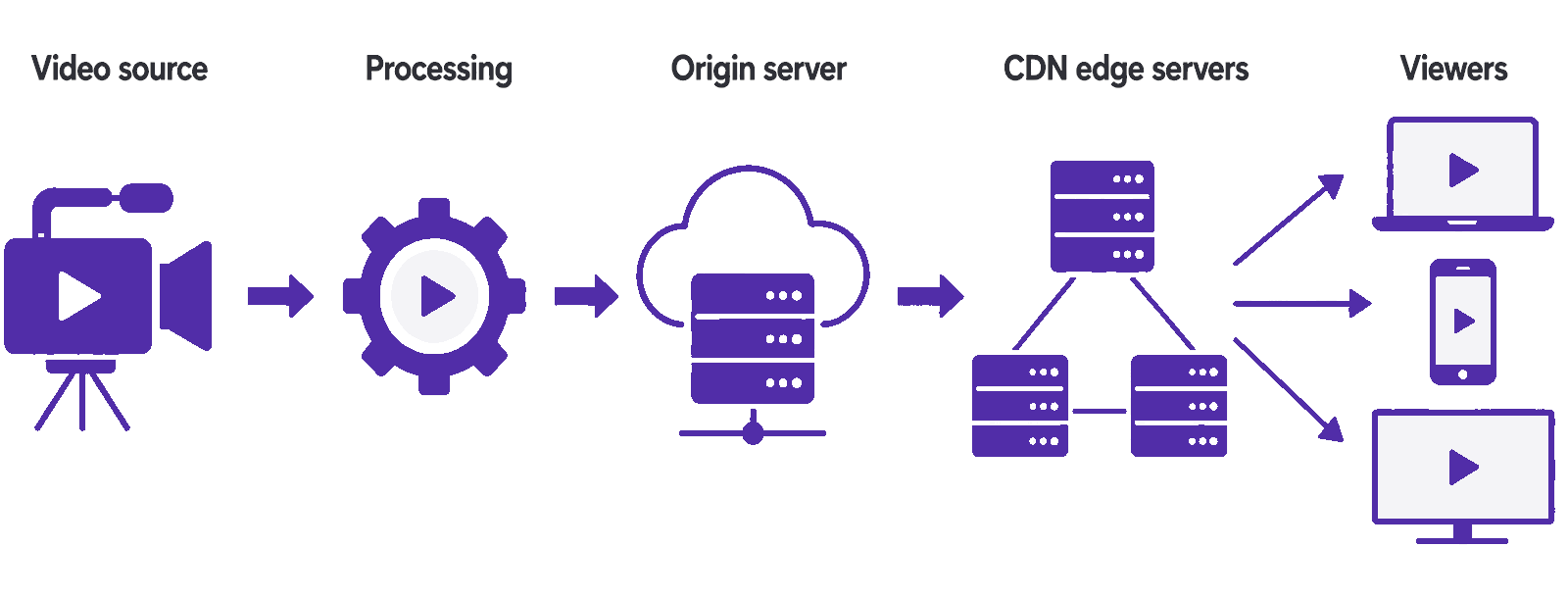
Video ingest or upload
Live video enters through an ingest workflow from an encoder, camera system, or production platform. On-demand video is uploaded to storage or an origin server before viewers request it.
Processing and packaging
Video is encoded or transcoded into multiple resolutions and bitrates. It is often divided into short segments and packaged in formats such as HLS or MPEG-DASH, allowing different devices and connections to receive suitable versions.
Origin storage and distribution
The origin stores primary video files or makes live segments available. When an edge server does not have a requested segment, it retrieves it from the origin. Sending large amounts of data directly from one origin can create bandwidth, capacity, and reliability constraints.
Edge caching and request routing
The CDN routes each request to an appropriate edge server based on location, availability, capacity, and network conditions. Cached segments can be delivered immediately, while uncached content may be retrieved and stored for subsequent requests.
Adaptive playback
Adaptive bitrate streaming allows the video player to change quality levels as bandwidth and device conditions change. This helps maintain playback instead of forcing every viewer to receive the same bitrate.
Video CDN vs. Traditional CDN
A traditional CDN commonly accelerates web pages, images, scripts, software downloads, and other web content. A video CDN uses similar distributed infrastructure but is configured for large media files, segmented delivery, and continuous playback.
| Dimension | Traditional CDN | Video CDN |
|---|---|---|
| Primary content | Web assets and downloads | Live and on-demand video |
| Delivery pattern | Individual asset requests | Continuous segment requests |
| Key metrics | Page load times and cache performance | Startup time, buffering, bitrate, and stability |
| Typical capabilities | Static caching and web acceleration | Streaming optimization, large-file delivery, and adaptive bitrate support |
Video CDNs are specialized applications of CDN technology rather than completely separate networks.
Video CDN for On-Demand Video vs. Live Streaming
Video on demand
Video on demand is prerecorded and stored before playback. Popular files can remain cached for longer periods, making repeated delivery efficient. VOD services may also support large libraries, seeking, multiple quality levels, and hosted video accessed across different devices.
Live streaming
Live streaming distributes video while it is being produced. Newly created segments must reach viewers quickly and reliably, often during sudden traffic spikes. Low latency, real-time monitoring, high concurrency, and fast failover are therefore more important.
For a deeper explanation of ingest, protocols, latency, and real-time delivery, read our guide to live streaming CDNs.
Benefits of Using a Video CDN
Reduced buffering and faster startup
Edge servers shorten the network path between video content and viewers. Faster access to video segments can improve performance by reducing startup delay, rebuffering, and playback interruptions.
Better global video performance
A single origin may perform well for nearby users but create longer routes for distant audiences. Distributed edge locations and data centers help provide more consistent delivery across countries, regions, and internet service providers.
Improved scalability
A video CDN distributes demand across many servers rather than concentrating it at the origin. This supports popular releases, viral clips, seasonal traffic, and high-concurrency live events.
Lower origin infrastructure load
Cached content can be served without returning to the origin for every request. Higher cache efficiency reduces bandwidth costs, connection volume, and infrastructure pressure.
More consistent playback quality
Adaptive bitrate streaming, edge delivery, and intelligent routing help players respond to changing network conditions. Viewers can receive a sustainable quality level rather than repeatedly stalling at a bitrate their connections cannot maintain.
Better resilience and availability
Multiple edge locations create alternative delivery paths when a server or network route becomes congested or unavailable. Traffic management and failover can help maintain service during local disruptions.
Key Components of a Video CDN
A video CDN typically combines:
- Video sources that provide live feeds or uploaded media.
- Origin and storage systems that hold primary files or live segments.
- Processing and packaging systems that encode, transcode, and segment video.
- Edge servers that cache or relay content near viewers.
- Request-routing systems that select suitable delivery locations.
- Video players that request segments and adjust playback quality.
- Analytics and monitoring tools that track traffic, errors, buffering, and viewing quality.
These components work together to move video from its source to viewers while balancing quality, capacity, and reliability.
Common Video CDN Use Cases
OTT and entertainment platforms use video CDNs to serve large libraries across multiple regions.
Sports and live-event services rely on scalable delivery during rapid audience spikes.
Education platforms distribute courses, webinars, virtual classrooms, and training libraries.
Enterprise video systems support town halls, product training, and internal broadcasts.
News and media organizations deliver live channels, breaking coverage, interviews, and clips.
Gaming, social, and ecommerce applications use video delivery for tournaments, short-form feeds, creator streams, product demonstrations, and live shopping.
When Do You Need a Video CDN?
A video CDN becomes relevant when direct delivery from cloud storage or one origin no longer provides acceptable performance, scale, or reliability.
Common signs include:
- Viewers are distributed across several countries or regions.
- Users experience buffering or slow startup.
- Origin bandwidth and infrastructure costs are growing.
- Traffic is unpredictable, seasonal, or event-driven.
- The platform maintains a large VOD library.
- Live events require high concurrency.
- Playback quality varies significantly by location.
- One origin has become a delivery bottleneck.
Business size alone does not determine the need. A small platform serving a global audience or a major live event may need CDN delivery sooner than a larger service with a local audience.
CDNetworks Video CDN Capabilities
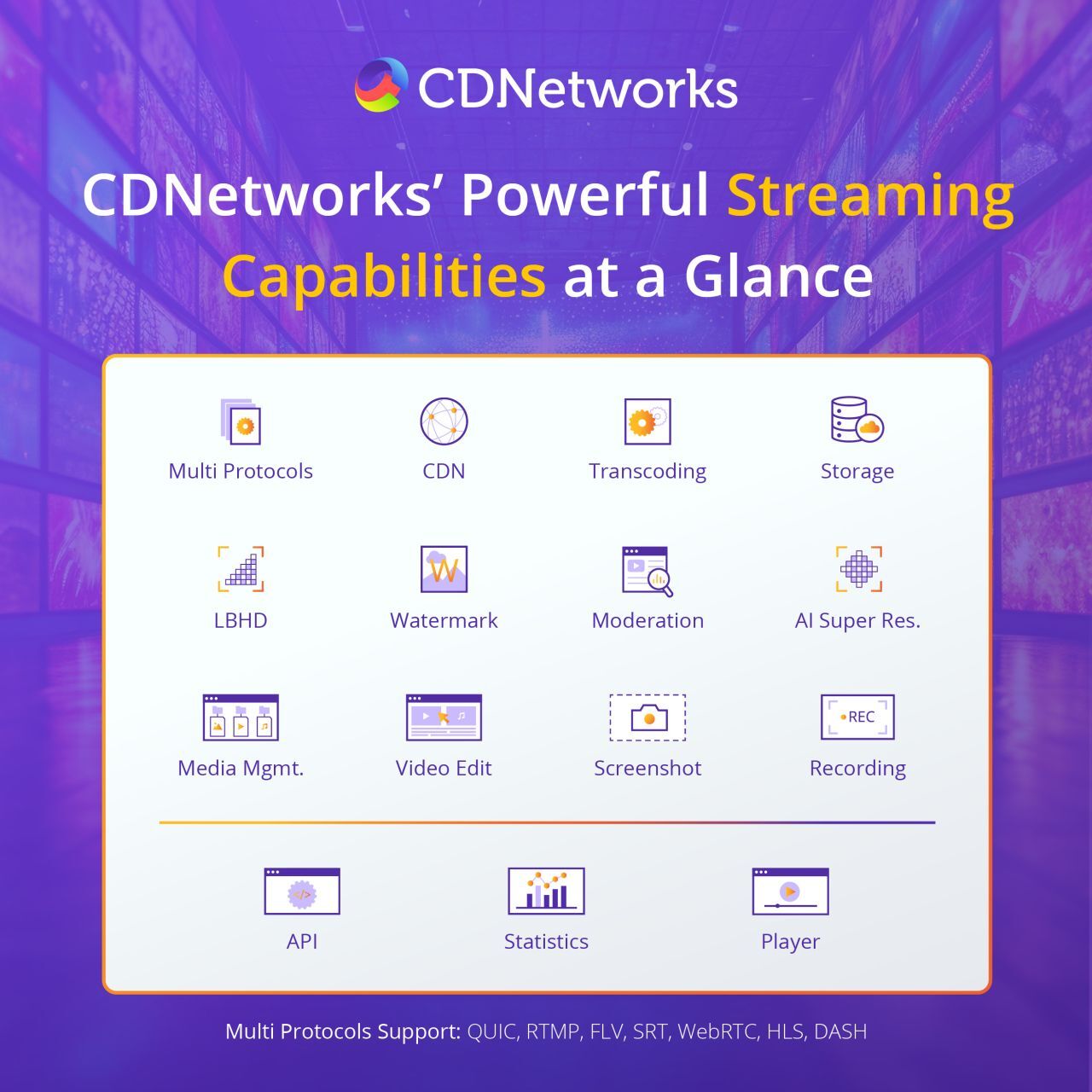
CDNetworks supports video delivery through its Media Delivery solutions, covering both live streaming and video on demand.
Its distributed delivery infrastructure, video processing capabilities, adaptive bitrate support, content protection, and monitoring tools help businesses deliver video across devices and regions.
Organizations can use CDNetworks to reduce origin pressure, manage traffic peaks, improve playback stability, and support media workflows without independently building and operating a global delivery network.
Learn more about CDNetworks’ video CDN solutions:
Video CDN FAQs
Is a video CDN different from a regular CDN?
Video CDNs optimize CDN infrastructure for large media files, segmented streaming, continuous playback, adaptive bitrates, and sudden traffic spikes. Regular CDNs commonly focus on accelerating web pages, images, scripts, and downloads.
Can a video CDN deliver both live and on-demand video?
Video CDNs can deliver both formats. Live delivery prioritizes rapid segment distribution and low latency, while on-demand delivery relies more heavily on storage, caching, seeking, and repeated access to prerecorded files.
Does a video CDN store video content?
Caching stores requested video temporarily at edge servers. Origin storage holds primary files, while some video CDN services provide integrated long-term storage as a separate or bundled capability.
How does a video CDN reduce buffering?
Edge servers shorten network paths, cached segments reduce origin retrieval, routing avoids congested locations, and adaptive bitrate streaming selects a quality level suited to the viewer’s current connection.
Do small video platforms need a video CDN?
Audience distribution, traffic patterns, content volume, and performance requirements determine the need. Small platforms may benefit when serving global viewers, experiencing traffic spikes, or struggling to scale from one origin.
Can a video CDN improve video security?
Security features may include token authentication, signed URLs, encryption, access controls, hotlink protection, and DDoS mitigation. Available protections depend on the provider, architecture, and implementation.
What is the difference between a video CDN and a video platform?
Video CDNs primarily distribute content. Video platforms may also provide uploading, storage, transcoding, management, players, analytics, monetization, and delivery through an integrated or third-party CDN.