
A live streaming CDN is a distributed network of edge servers that delivers live video streams to viewers with lower latency, less buffering, and higher reliability. Instead of sending every viewer request back to a central origin server, a live streaming CDN distributes traffic across edge locations closer to the audience.
For broadcasters, OTT platforms, online education providers, live commerce platforms, gaming companies, and enterprises, this becomes critical when live events attract large audiences, global viewers, or sudden traffic spikes.
This guide explains how a live streaming CDN works, how it differs from a regular CDN or general video CDN, which latency and protocol requirements to consider, and how to choose the right solution for professional live video delivery.
What Is a CDN?
A content delivery network, or CDN, is a distributed network of servers that delivers digital content to users from locations closer to them. Instead of every user requesting content directly from a central origin server, a CDN routes requests to nearby edge servers.
For live streaming, this matters because video traffic is bandwidth-intensive, time-sensitive, and highly vulnerable to traffic spikes.
What Is a Live Streaming CDN?
A live streaming CDN is a type of video CDN built for real-time or near-real-time video delivery. It distributes live streams across a network of edge servers so viewers can receive video from a location closer to them instead of relying on a single origin server.
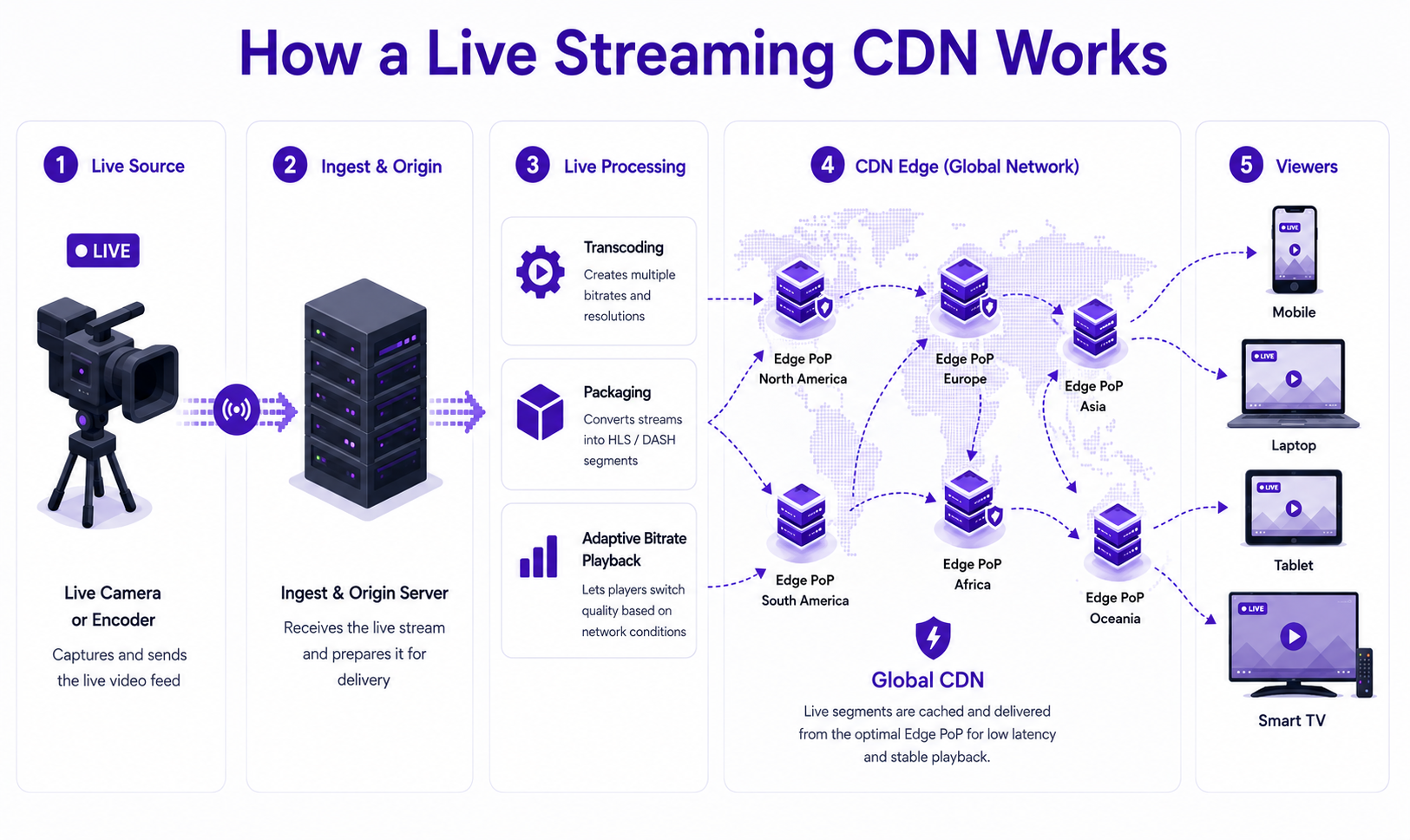
In a typical workflow, a live feed is captured by a camera or production system, encoded into a digital stream, sent to an ingest point, packaged into streaming formats, and delivered through CDN edge nodes to viewers’ devices.
A video CDN may support both video-on-demand and live streaming. A live streaming CDN focuses specifically on the requirements of live video, including low latency, continuous segment delivery, high traffic spikes, live event reliability, and fast troubleshooting.
| CDN type | Main use case | Key delivery focus |
|---|---|---|
| Traditional CDN | Websites, images, scripts, downloads | Web acceleration and content caching |
| Video CDN | Video-on-demand and live video | Video delivery, playback quality, bandwidth efficiency |
| Live streaming CDN | Live broadcasts and real-time video | Low latency, high concurrency, failover, live playback stability |
A live streaming CDN is especially important for use cases such as sports events and live tournaments, OTT live channels, news broadcasting, live shopping and interactive commerce, and gaming and esports.
For small, private streams with limited viewers, a basic streaming platform may be enough. For public events, global audiences, premium content, or unpredictable traffic spikes, a purpose-built live streaming CDN becomes a core infrastructure layer.
How Does a Live Streaming CDN Work?
A live streaming CDN works by moving live video through a delivery chain that starts at the source and ends at the viewer’s device. Each step affects latency, buffering, stability, and picture quality.
Capture and Encoding
The live stream begins with a video source, such as a camera, production system, screen capture tool, broadcast encoder, or mobile device. The raw signal is encoded into a compressed digital format so it can be transmitted over the internet.
Encoding settings matter. Bitrate, resolution, frame rate, keyframe interval, and bitrate ladder design can all affect latency and buffering. A strong CDN cannot fully compensate for an unstable source stream or poorly designed encoding profile.
Stream Ingest
After encoding, the stream is sent to an ingest point. The ingest layer receives the live feed and passes it into the media delivery workflow.
Common ingest protocols include RTMP and SRT.
- RTMP is widely supported by encoders and production tools.
- SRT is often used for contribution feeds that need stronger reliability over unstable networks. For professional live events, backup ingest endpoints are usually recommended.
Transcoding and Packaging
Once the stream reaches the media platform or origin infrastructure, it may be transcoded into multiple bitrate and resolution versions. This makes adaptive bitrate streaming possible.
The stream is then packaged into playback formats such as HLS, MPEG-DASH, LL-HLS, or CMAF-based low-latency formats. Packaging breaks the stream into smaller segments or chunks that can be delivered efficiently through the CDN.
Edge Distribution
After packaging, the live stream is distributed through CDN edge servers. When a viewer requests the stream, the CDN routes the request to an appropriate edge location.
If the requested stream segment is already available at the edge, it is delivered directly. If not, the edge server retrieves it from the origin or an upper-tier cache. This reduces origin load and shortens the network path between the stream and the viewer.
Adaptive Bitrate Playback
Adaptive bitrate streaming, or ABR, allows the video player to switch between quality levels based on each viewer’s network condition, device capability, and available bandwidth.
A viewer on a fast connection may receive a 1080p or 4K stream, while a viewer on a congested mobile network may receive a lower bitrate version. The goal is smooth playback, not forcing every viewer to load the same stream quality.
Monitoring and Failover
Live streaming requires real-time visibility. Delivery teams need to monitor startup time, rebuffering ratio, playback errors, latency, traffic volume, origin load, and regional performance while the event is happening.
Failover is also critical. If one stream source, route, or delivery path fails, the system should recover quickly. For premium live events, monitoring and failover should be planned before the event begins.
Why Use a CDN for Live Streaming? 6 Benefits
A live streaming CDN improves the delivery experience for both viewers and content providers. It is especially valuable when streams need to reach large audiences, distributed regions, or latency-sensitive use cases.
-
Lower latency and less buffering:
Edge servers deliver live video from locations closer to viewers, reducing delivery distance and improving playback stability. -
Scalability for live traffic spikes:
Sports matches, product launches, concerts, and breaking news can attract large audiences within minutes. A live streaming CDN distributes requests across edge servers instead of sending all traffic to the origin. -
More consistent global playback:
Viewers in different regions face different network paths, ISP conditions, and last-mile quality. A global CDN helps deliver streams from edge locations closer to each audience. -
Reduced origin load:
CDN edge delivery reduces direct requests to the origin. Origin shielding, tiered caching, and request optimization can further protect the origin during high-concurrency events. -
Higher reliability:
Distributed delivery, route optimization, redundancy, and failover support help keep live streams available even when one path or node has issues. -
Stronger content protection:
A live streaming CDN can support token authentication, signed URLs, HTTPS delivery, geo-restriction, access control, DDoS protection, hotlink protection, and DRM integration.
Types of Live Streaming CDN Architectures
Live streaming CDN architecture affects scalability, reliability, cost, control, and operational flexibility. The right model depends on traffic patterns, audience locations, latency goals, and business requirements.
Push CDN vs. Pull CDN
In a pull CDN model, the CDN retrieves content from the origin when a viewer requests it. This model is common for websites and video-on-demand because the content already exists before the request.
In a push CDN model, content is proactively pushed to the CDN infrastructure. For live streaming, push-based or pre-distribution workflows can be useful when content must be made available quickly and consistently across many edge locations.
Many live streaming workflows use a hybrid model. The origin, packaging system, and CDN work together so new stream segments can be delivered quickly without overwhelming the origin.
Single CDN vs. Multi-CDN
A single CDN setup uses one CDN provider for live stream delivery. It is simpler to manage and may be enough for predictable traffic, regional audiences, or smaller events.
A multi-CDN strategy uses more than one CDN provider. Traffic can be routed based on geography, performance, cost, or availability. This can improve resilience for major events, global audiences, and mission-critical broadcasts.
Multi-CDN delivery adds operational complexity, including traffic steering, monitoring, reporting, and provider coordination. It is most useful when the business impact of downtime or regional performance issues is high.
Public CDN vs. Private CDN
A public CDN uses shared infrastructure to deliver content for many customers. It is flexible and efficient for many live streaming use cases.
A private CDN is built or reserved for a specific organization or use case. Broadcasters, OTT platforms, and large enterprises may consider private or dedicated delivery models when they need more control, predictable capacity, customized routing, or special compliance requirements.
The better question is not simply whether a public or private CDN is better. The better question is how much control, capacity, customization, and live event support your workflow requires.
Key Features to Look for in a Live Streaming CDN
A live streaming CDN should be evaluated based on delivery requirements, not just price or network size. The following features are especially important for professional live video delivery.
Low-Latency Streaming Support
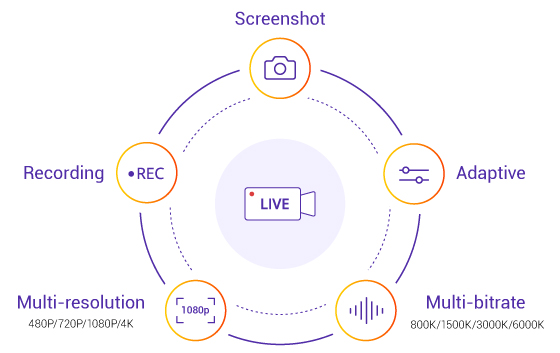
The CDN should support the latency level your use case requires. A one-way broadcast may prioritize stability and scale, while an interactive event may require a low-latency or ultra-low-latency workflow. Look for support for LL-HLS, CMAF-based delivery, or WebRTC when those formats match the use case.
Adaptive Bitrate Streaming
Adaptive bitrate streaming helps maintain smooth playback across different network conditions. A CDN should deliver multiple bitrate renditions efficiently and support fast switching between them. This is essential for global audiences where device types, connection speeds, and last-mile conditions vary widely.
Global Edge Network Coverage
CDN coverage should match viewer geography. A large network is useful, but relevant regional performance matters more than raw PoP count. Before choosing a live streaming CDN, identify your primary audience markets and evaluate whether the CDN has strong delivery capability in those regions.
Origin Shielding and Cache Efficiency
Origin protection is critical during large live events. A CDN should reduce direct requests to the origin and prevent the origin from becoming a bottleneck. Origin shielding, tiered caching, and request optimization can improve resilience when traffic spikes.
Security and Access Control
Live video security should be built into the delivery workflow. Important capabilities include token authentication, signed URLs, geo-blocking, HTTPS delivery, DDoS protection, hotlink protection, and DRM integration. For premium or rights-protected content, security is part of the live streaming CDN requirement.
Real-Time Analytics and QoE Monitoring
Live streaming teams need visibility while the event is happening. Useful metrics include startup time, rebuffering ratio, playback error rate, latency, bitrate changes, concurrent viewers, origin load, and regional performance. Real-time monitoring helps operations teams identify issues before they affect a large share of viewers.
Technical Support for Live Events
Live streaming is operationally sensitive. When a major event is live, support speed and technical depth matter. A professional live streaming CDN provider should understand encoder configuration, ingest behavior, protocol selection, CDN routing, playback troubleshooting, and traffic spikes.
CDNetworks Live Streaming CDN Solutions
CDNetworks provides live streaming CDN and video CDN solutions built for high-quality, low-latency, and cost-efficient media delivery.
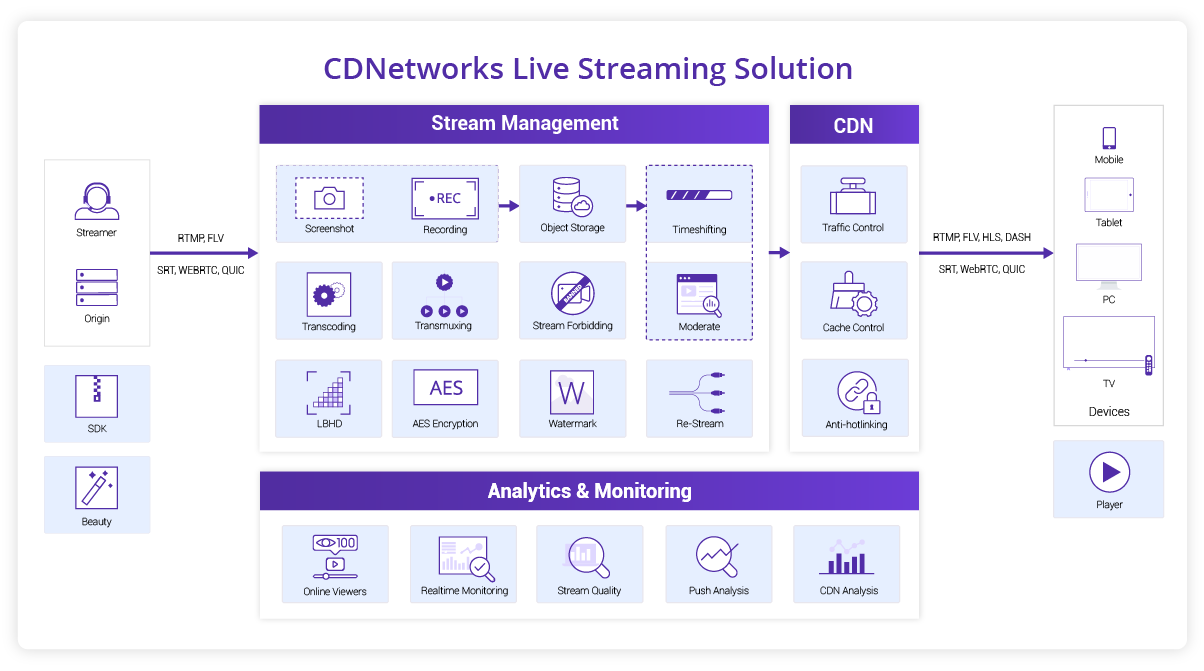
Our streaming network includes 3,000+ global CDN PoPs, 200+ Tbps CDN capacity, 200,000+ global servers, and ultra-low-latency streaming achieved via WebRTC.
For live streaming teams, protocol and media technology support matters because ingest, delivery, compatibility, latency, and cost are all connected.
CDNetworks supports a broad streaming workflow, including enhanced RTMP/FLV support, QUIC-based delivery, WebRTC ultra-low-latency streaming, H.266 codec optimization, and 8K transcoding.
| Supported protocol or media technology | Best used for | CDNetworks value |
|---|---|---|
| RTMP/FLV | Live stream ingest and playback workflows | Broad compatibility with tools such as OBS and VLC |
| QUIC | Fast and secure streaming delivery | Faster connections, reliable playback on poor networks, improved transmission efficiency |
| WebRTC | Ultra-low-latency live streaming | Sub-500 ms latency for real-time and interactive streaming scenarios |
| H.266 codec | High-efficiency video compression | Up to 50% bitrate reduction compared with H.265 at the same perceptual quality |
| 8K transcoding | Ultra-high-resolution streaming | Global 8K delivery support while lowering bitrate and transmission costs |
| AI Super Resolution | Video quality enhancement | Upscales lower-quality feeds without requiring expensive source upgrades |
By combining CDN scale, protocol support, video optimization, and edge delivery, CDNetworks helps teams deliver live video from ingest to playback with stronger performance, lower cost pressure, and better viewer experience.
Live Streaming CDN FAQ
Is a live streaming CDN different from a regular CDN?
Live streaming CDNs are optimized for real-time video delivery with minimal delay, while regular CDNs primarily accelerate static files and cached content. Live streaming CDNs prioritize low latency, scalability, and uninterrupted playback for live audiences.
Why do I need a CDN for live streaming?
CDN infrastructure distributes live video across globally located edge servers, reducing buffering, improving stream quality, handling traffic spikes, and delivering consistent viewing experiences for audiences regardless of their location.
How does a live streaming CDN reduce latency?
Edge servers deliver live video from locations closer to viewers, minimizing network distance and congestion. Optimized routing, intelligent caching, and low-latency streaming protocols further reduce delays between the live source and the audience.
What protocols should a live streaming CDN support?
Protocols should include HLS, DASH, WebRTC, RTMP, and SRT to support reliable ingest, adaptive bitrate streaming, low latency delivery, and broad compatibility across browsers, mobile devices, smart TVs, and streaming platforms.