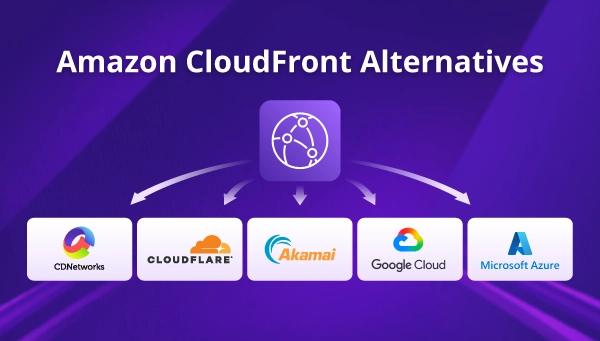
Looking for an Amazon CloudFront alternative? Five CDN providers worth evaluating in 2026 are CDNetworks, Cloudflare, Akamai, Google Cloud CDN, and Microsoft Azure.
Each is suited to different delivery requirements, from regional performance and security to cloud infrastructure integration. The right choice depends on where your users are located, how your applications are deployed, and what you need from your CDN.
Amazon CloudFront remains a strong option for organizations invested in AWS. However, businesses with specific regional performance requirements, multi-cloud environments, or evolving delivery and security needs may benefit from evaluating other providers.
CDNetworks is particularly well suited to enterprises delivering content across APAC, mainland China, and other markets where local network connectivity and hands-on support are important. For businesses affected by the upcoming end of CloudFront support in AWS China (Ningxia), it is also an option worth evaluating as part of their migration planning.
For organizations using CloudFront in the AWS China (Ningxia) region, the announced service discontinuation on May 31, 2027, also makes evaluating alternatives a more immediate priority.
This guide compares the five providers and explains when each option makes sense for businesses evaluating an alternative to CloudFront.
Amazon CloudFront Alternatives at a Glance
The five alternatives below address different delivery and infrastructure needs rather than serving as direct, one-to-one replacements for Amazon CloudFront. Use this table to identify the providers that best fit your requirements.
| Provider | Best Suited For | Main Strength | Key Consideration |
|---|---|---|---|
| CDNetworks | Businesses prioritizing delivery across APAC, mainland China, and emerging markets | Regional network connectivity, China delivery options, integrated security, and expert support | Businesses seeking a fully self-service CDN experience should evaluate available management and support options |
| Cloudflare | Teams consolidating CDN, DNS, and application security | Unified edge platform for delivery and security | Requires confirmation of whether advanced features, support, and China delivery require a higher-tier plan or additional subscription |
| Akamai | Large enterprises with complex global media and application delivery requirements | Broad CDN and application-security capabilities | Enterprise procurement and configuration may require additional coordination |
| Google Cloud | Applications built around Google Cloud | Native integration with Google Cloud infrastructure | Requires a Google Cloud load-balancing architecture, including for external origins |
| Microsoft Azure | Azure-centric and multiregional web applications | Global routing, CDN caching, and integrated WAF capabilities | Evaluates whether the selected service tier covers the required features and deployment needs within budget |
Why Should You Consider an Amazon CloudFront Alternative in 2026?
Amazon CloudFront is a reliable choice for content delivery, especially for businesses operating within the AWS ecosystem. Still, there are several reasons an organization may want to evaluate alternative or complementary CDN providers.
CloudFront Support in AWS China (Ningxia) Ends in 2027
AWS has announced that support for Amazon CloudFront in the Amazon Web Services China (Ningxia) region will end on May 31, 2027, including the decommissioning of the four China Points of Presence (PoPs) in Shenzhen (SZX), Shanghai (PVG), Ningxia (ZHY), and Beijing (BJS). AWS also stopped accepting new customers after September 30, 2026.
Businesses relying on this service for mainland China delivery should assess their options early. Evaluating alternative CDNs in advance allows more time for migration, testing, and planning to minimize service disruption.
Better Performance in Your Target Markets
CloudFront operates a broad global edge network, but actual performance varies according to user geography, ISP connectivity, network routing, cache configuration, content type, and origin location.
In markets such as Asia-Pacific, Latin America, and the Middle East, these factors can affect latency and connection stability for applications such as e-commerce, video streaming, and online gaming.
If CloudFront does not consistently meet performance requirements in key markets, comparing alternative CDNs may help identify providers with better regional coverage or connectivity for your users.
Greater Control Over CDN Costs
CloudFront offers both pay-as-you-go pricing and flat-rate plans, but the best fit depends on traffic volume and delivery requirements.
Under pay-as-you-go pricing, costs can vary with data transfer, HTTP requests, geographic traffic distribution, and additional services. Flat-rate plans offer more predictable expenses, but their included features and usage limits may not suit every workload.
For businesses with growing traffic or changing regional demand, comparing alternative CDN pricing models may reveal opportunities to improve budget predictability or reduce overall delivery costs.
Simpler Management Across Cloud and Security Environments
Amazon CloudFront integrates with AWS WAF and AWS Shield, making it easier to manage security within the AWS ecosystem. However, as deployments span multiple services or cloud environments, coordinating security policies, access controls, and monitoring can increase operational complexity.
For businesses facing these challenges, alternative CDNs may offer security management workflows that better fit their infrastructure, helping simplify operations and maintain consistent policy enforcement.
Less Dependence on a Single CDN Provider
Businesses adopting multi-cloud architectures or requiring independent traffic failover may find that relying on a single CDN limits their flexibility. Provider-specific policies, cross-cloud transfer costs, and separate configuration workflows can complicate traffic management across environments.
Evaluating alternative CDNs or a multi-CDN strategy may provide greater control over traffic routing and resilience, particularly when independent failover or reduced vendor dependence is a business priority.
How to Evaluate an Amazon CloudFront Alternative
Once you have identified where CloudFront may fall short, use the following criteria to compare alternatives against your workload and operational priorities:
- Workload fit: Keep CloudFront for suitable AWS-native workloads, while evaluating alternatives for stronger regional reach, China continuity, or independent multi-CDN routing.
- Regional performance: Test latency, cache hit ratios, availability, and throughput in priority markets.
- China delivery: Verify mainland China coverage, origin access, regulatory requirements, and cutover support ahead of the May 31, 2027 end of CloudFront support in AWS China (Ningxia).
- Security: Compare WAF, DDoS, bot, and API protection workflows, including whether a unified control plane would simplify operations for your team.
- Total cost: Model bandwidth, requests, cache misses, origin egress, add-ons, and support using real traffic.
- Origin compatibility: Validate multi-cloud, SaaS, and private origins alongside TLS, cache-key, and authentication requirements.
- Support: Assess migration guidance, regional expertise, incident response, and SLAs.
5 Top Amazon CloudFront Alternatives
While the comparison table compares key specifications, selecting the right CloudFront alternative depends on how each provider aligns with your priorities. The profiles below highlight each provider’s strengths and the main deployment considerations to assess before migrating.
1. CDNetworks
Best for: Businesses prioritizing delivery across APAC, mainland China, and emerging markets, including Southeast Asia, South Asia, Latin America, the Middle East, and Africa.
CDNetworks operates more than 3,000 PoPs across over 90 countries and regions. Its regional network and local ISP connectivity make it especially relevant for organizations evaluating performance in APAC and mainland China. Its Global to China solution describes delivery resources spanning more than 140 mainland Chinese cities, although customers should confirm the precise coverage and service scope for their deployment.
Beyond content delivery, CDNetworks offers Cloud Security 2.0, which brings together DDoS protection, a web application firewall (WAF), bot management, and API security. Its 24/7 technical support and professional services are also relevant to teams that want assistance with regional delivery design and migration planning.
CDNetworks is particularly worth considering for businesses preparing to replace CloudFront in AWS China (Ningxia), as well as organizations delivering video, software, or other performance-sensitive content across multiple APAC markets. For a simple AWS-centric deployment with limited regional requirements, retaining CloudFront may be the more practical option.
2. Cloudflare
Best for: Teams looking to consolidate CDN, DNS, and application security on a unified platform.
Cloudflare appeals to organizations seeking to consolidate global CDN, DNS, DDoS mitigation, WAF, bot controls, and serverless compute onto one platform, eliminating the friction of managing fragmented services across separate dashboards.
For mainland China delivery, Cloudflare offers a dedicated China Network, but access requires an Enterprise plan, a separate China Network subscription, and applicable ICP documentation and domain review. Not all global Cloudflare features are available on its China Network, so businesses should verify the services supported in their target markets.
3. Akamai
Best for: Large enterprises managing complex global media delivery, web applications, and security requirements.
Akamai serves large enterprises with demanding global media delivery and application security needs, offering deep network scale and seasoned professional services. However, procurement, staging workflows, and modular configurations require significant upfront planning.
Since Akamai China CDN was discontinued on July 6, 2026, organizations evaluating Akamai as a CloudFront alternative should assess mainland China delivery continuity separately.
4. Google Cloud
Best for: Applications built around Google Cloud infrastructure.
Google Cloud CDN is a strong choice for workloads using Google Cloud’s global external Application Load Balancer. It supports both Google Cloud backends and external origins hosted on-premises or in other clouds.
However, adopting Cloud CDN requires the appropriate Google Cloud load-balancing architecture and associated configuration. Google’s published Cloud CDN cache-location list does not include mainland China, so organizations requiring in-country delivery should evaluate a separate CDN solution.
5. Microsoft Azure
Best for: Azure-centric organizations and multiregional web applications.
Microsoft Azure serves as a viable CloudFront alternative for organizations expanding into Microsoft Azure or operating hybrid AWS-Azure environments. Combining global Layer 7 load balancing, dynamic site acceleration, and native Azure WAF policies, the service streamlines application delivery through familiar Microsoft management workflows.
While mainland China delivery may require a separate China-specific architecture, Microsoft Azure remains a viable option for Azure-centered workloads, subject to service availability and deployment requirements.
Why CDNetworks Is Worth Considering as a Strong Alternative to Amazon CloudFront
CDNetworks and CloudFront can both support enterprise content delivery, but their strongest use cases differ.
For organizations evaluating a replacement or a complementary CDN, the practical questions are regional fit, available security capabilities, pricing structure, origin access, and migration support.
| Dimension | CDNetworks | Amazon CloudFront |
|---|---|---|
| Global Network and Regional Reach | 3,000+ global PoPs across 90+ countries and regions, with a focus on local network connectivity in APAC and other regional markets | Broad global edge network with deep AWS integration |
| Mainland China Delivery | Extensive PoPs across 140+ mainland Chinese cities, dedicated China server groups, and ICP registration assistant | AWS China (Ningxia) support and all 4 mainland PoPs end on May 31, 2027 (no new sign-ups after Sep 30, 2026) |
| Security and DDoS Protection | Unified Cloud Security 2.0 (WAAP) combining Flood Shield 2.0, Bot Shield, and API Shield | Integrates with AWS WAF and DDoS protection; some security features are included in flat-rate plans, depending on tier |
| Multi-CDN Deployment and Resilience | Compatible with multi-cloud and multi-CDN setups | AWS-centric design with tight coupling to native AWS services |
| Pricing Model | Pricing is primarily custom or traffic-based | Offers both usage-based pricing and flat-rate plans with different conditions and included features |
| Technical Support | 24/7 expert support with dedicated onboarding at no additional cost | AWS documentation and support options based on the selected support plan |
Cloudfront Alternatives FAQs
When Does Amazon CloudFront Support End in AWS China (Ningxia)?
Support for Amazon CloudFront in the AWS China (Ningxia) region will end on May 31, 2027, with all four mainland China PoPs in Shenzhen, Shanghai, Ningxia, and Beijing to be permanently decommissioned. AWS stopped accepting new customer registrations on September 30, 2026.
Does Using an Alternative CDN Require Moving Your Origin from AWS?
Using an alternative CDN does not necessarily require migrating your origin from AWS. Organizations can often retain existing Amazon S3 buckets, EC2 instances, and load balancers, provided the new CDN can securely reach the origin, and the required access, TLS, and caching configurations are supported.
Which CloudFront Alternatives Support Mainland China Delivery?
CDNetworks offers mainland China delivery capabilities through its Global to China solution, with published coverage across more than 140 cities.
Cloudflare also offers a China Network, subject to Enterprise subscription requirements and applicable onboarding conditions.
Other providers may require separate China-specific solutions or architectures. Businesses should verify current service availability, technical requirements, and applicable regulatory obligations directly with each vendor.
How Should Businesses Compare CDN Costs Across Regions?
Businesses should compare CDN costs across regions by evaluating:
- Data transfer fees: Compare bandwidth and data egress pricing.
- Request charges: Assess costs based on request volume.
- Performance: Consider cache hit ratios and origin traffic.
- Regional availability: Check coverage and infrastructure costs.
- Compliance: For mainland China, account for licensing requirements and deployment restrictions.
Which CDN Options Best Complement Amazon CloudFront for Global Delivery?
CDNetworks is worth considering for organizations seeking a complement ahead of CloudFront’s scheduled service discontinuation on May 31, 2027. With 3,000+ global PoPs, extensive mainland China coverage, integrated edge security, and dedicated technical support, CDNetworks can help businesses maintain reliable content delivery across China and global markets.