VOD stands for video on demand. It is a media distribution model that lets viewers choose and watch prerecorded video whenever they want instead of following a fixed broadcast schedule. Content may be streamed immediately or downloaded for later viewing on smartphones, tablets, computers, smart TVs, and other connected devices.
The plural term VODs refers to multiple on-demand videos. On gaming and livestreaming platforms, a VOD commonly means a saved recording that viewers can watch after a live broadcast has ended.
How Does VOD Work?
A VOD workflow begins when video content is uploaded to an origin server or storage platform. The video is then encoded into formats and quality levels suitable for different devices and network conditions.
Many services package video with streaming protocols such as HLS or DASH. The content is divided into smaller segments, allowing a compatible player to request and play each segment in sequence. Adaptive bitrate streaming can switch between quality levels as the viewer’s connection changes.
A content delivery network, or CDN, can cache these files on edge servers closer to viewers. This reduces the distance each video request must travel and helps the service deliver consistent playback to audiences in different locations. CDNetworks’ current VOD documentation supports adaptive bitrate delivery through both HLS and DASH formats.
What Are the Main Types of VOD?
VOD services commonly use one or more of the following models:
- SVOD, or subscription video on demand, gives viewers access to a content library for a recurring fee.
- AVOD, or advertising-based video on demand, provides free or lower-cost access supported by advertisements.
- TVOD, or transactional video on demand, charges viewers for an individual rental or purchase.
- PVOD, or premium video on demand, offers early or exclusive access for a higher one-time fee.
A platform may combine these models. For example, it might offer free advertising-supported videos, subscriber-only content, and premium rentals within the same service.
VOD vs. OTT and Live Streaming
VOD describes when viewers access content. They select prerecorded videos and watch them at a time of their choosing.
OTT, or over-the-top delivery, describes how media reaches viewers. OTT services deliver video, audio, or other content over the internet without relying on traditional cable, satellite, or broadcast distribution. An OTT service may offer VOD, live streaming, or both.
Live streaming delivers an event as it happens. VOD delivers content that has already been recorded and prepared for later playback. A live event can also be recorded and published as VOD after the broadcast ends.
Why is a CDN Used for VOD?
For VOD distribution, a CDN stores copies of video files or segments at edge locations closer to viewers.
Video files require significant bandwidth, especially when many viewers request high-resolution content at the same time. Serving every request from one origin can increase load and create longer delivery paths for distant users.
A CDN stores copies of video files or segments at distributed edge locations. Viewers can receive cached content from a nearby server, helping reduce startup delay, buffering, and origin traffic.
CDN delivery also helps VOD providers support larger audiences, regional demand, and sudden traffic spikes. Related technologies such as media servers can help manage stored media, playback formats, access policies, and delivery workflows.
Deliver VOD with CDNetworks
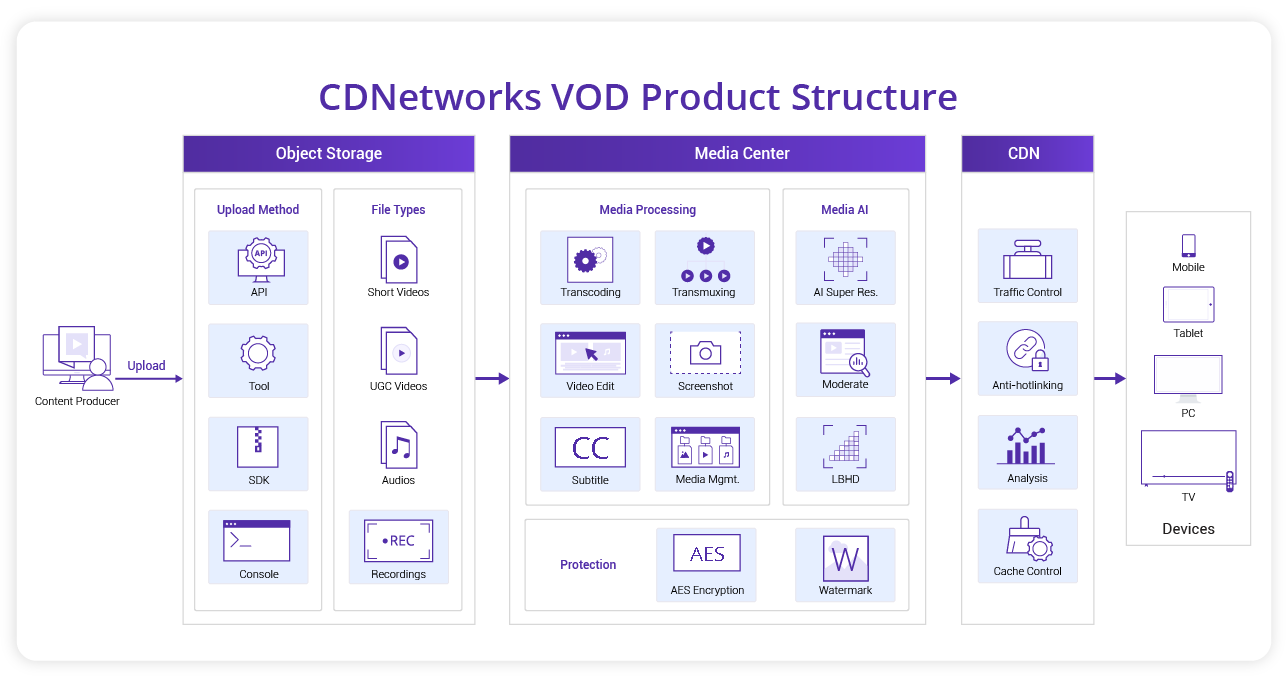
CDNetworks Media Acceleration VoD helps businesses deliver on-demand video across devices and locations. The solution combines global CDN delivery, customized caching, intelligent scheduling, media processing, and security capabilities to support fast, reliable, and scalable viewing experiences.
Learn how CDNetworks can support your VOD delivery requirements. →
Frequently Asked Questions
What Does VOD Mean?
VOD means video on demand, a media model that lets users select prerecorded content and watch it whenever they choose instead of following a fixed broadcast schedule.
What is a VOD on Twitch?
VODs are saved recordings of previous livestreams that viewers can replay after the original broadcast has ended, subject to the platform’s storage settings and retention period.
What is the Difference Between VOD and Live Streaming?
VOD delivers prerecorded content whenever a viewer chooses, while live streaming transmits an event as it happens. A live stream may later be recorded and published as VOD.
Why is a CDN Used for VOD?
Video CDNs cache video content closer to viewers, helping reduce startup delay, buffering, origin-server load, and delivery distance while supporting larger audiences and traffic spikes.