
AI crawlers are automated programs that discover and retrieve web content for AI-related uses, including model training, AI search, retrieval, and assistant responses.
In 2025, CDNetworks observed approximately 1.64 million AI bot requests per day, with 72.67% associated with data scraping and content retrieval.
For businesses, the question is not whether AI crawlers are simply good or bad. Different crawlers serve different purposes, so access decisions should consider identity, intent, behavior, content sensitivity, and business value.
What are AI Crawlers?
An AI crawler, sometimes called an AI web crawler or LLM crawler, is a bot that accesses websites so an AI system can discover, collect, index, or retrieve content.
Technically, AI crawlers often operate much like traditional web crawlers: they send HTTP requests, follow links, retrieve resources, and process returned content. The key difference is how that content may ultimately be used, such as for model development, AI-powered search, real-time retrieval, or assistant-driven tasks.
How AI crawlers work
AI crawlers typically discover URLs, request web resources, process accessible content, and send relevant information to an AI-related system. Their crawl frequency, depth, purpose, and handling of website directives can vary by provider.
AI Crawlers vs. Traditional Web Crawlers
Traditional search crawlers primarily discover and index pages for conventional search results. AI crawler bots may support broader workflows, including model development, AI search, and user-requested retrieval.
| Crawler Type | Typical Purpose | Examples |
|---|---|---|
| Search crawler | Search indexing and discovery | Googlebot |
| AI training crawler | Model development or improvement | GPTBot, ClaudeBot |
| AI search crawler | AI search discovery and indexing | OAI-SearchBot, Claude-SearchBot |
| User-triggered fetcher | Retrieve content in response to users | Claude-User, Perplexity-User |
OpenAI distinguishes GPTBot from OAI-SearchBot, allowing publishers to manage potential training access separately from visibility in ChatGPT search. Anthropic similarly distinguishes ClaudeBot, Claude-SearchBot, and Claude-User.
What are the Main Types of AI Crawlers?
AI training crawlers
AI training crawlers collect web content that may contribute to model development or improvement. Organizations may choose to restrict these crawlers when copyrighted, proprietary, licensed, or commercially sensitive content is involved.
AI search crawlers
AI search crawlers discover and index content for AI-powered search and answer experiences. Blocking them may therefore affect discoverability. OpenAI states that publishers should allow OAI-SearchBot if they want their content included in ChatGPT search summaries and snippets.
User-triggered retrieval bots
User-triggered bots retrieve content in response to a specific user action rather than continuously crawling the web. Anthropic documents Claude-User separately from its search and training-related crawlers, while Perplexity distinguishes Perplexity-User from PerplexityBot.
Data scrapers and unverified bots
Not every automated request has a clear identity or purpose. CDNetworks categorizes AI bot activity into Data Scrapers, Assistants/Agents, Search Crawlers, and Unverified Agents, reflecting the different intents behind automated access.
Common AI Crawlers and What They Do
| Provider | Crawler | Primary Purpose |
|---|---|---|
| OpenAI | GPTBot | Potential model training use |
| OpenAI | OAI-SearchBot | ChatGPT search |
| Anthropic | ClaudeBot | Model development |
| Anthropic | Claude-SearchBot | AI search |
| Anthropic | Claude-User | User-triggered retrieval |
| Perplexity | PerplexityBot | Search discovery |
| Perplexity | Perplexity-User | User-triggered retrieval |
Crawler policies and network information can change, so organizations should verify crawler identities against current provider documentation before creating allow or block rules. Perplexity, for example, publishes separate IP ranges for PerplexityBot and Perplexity-User.
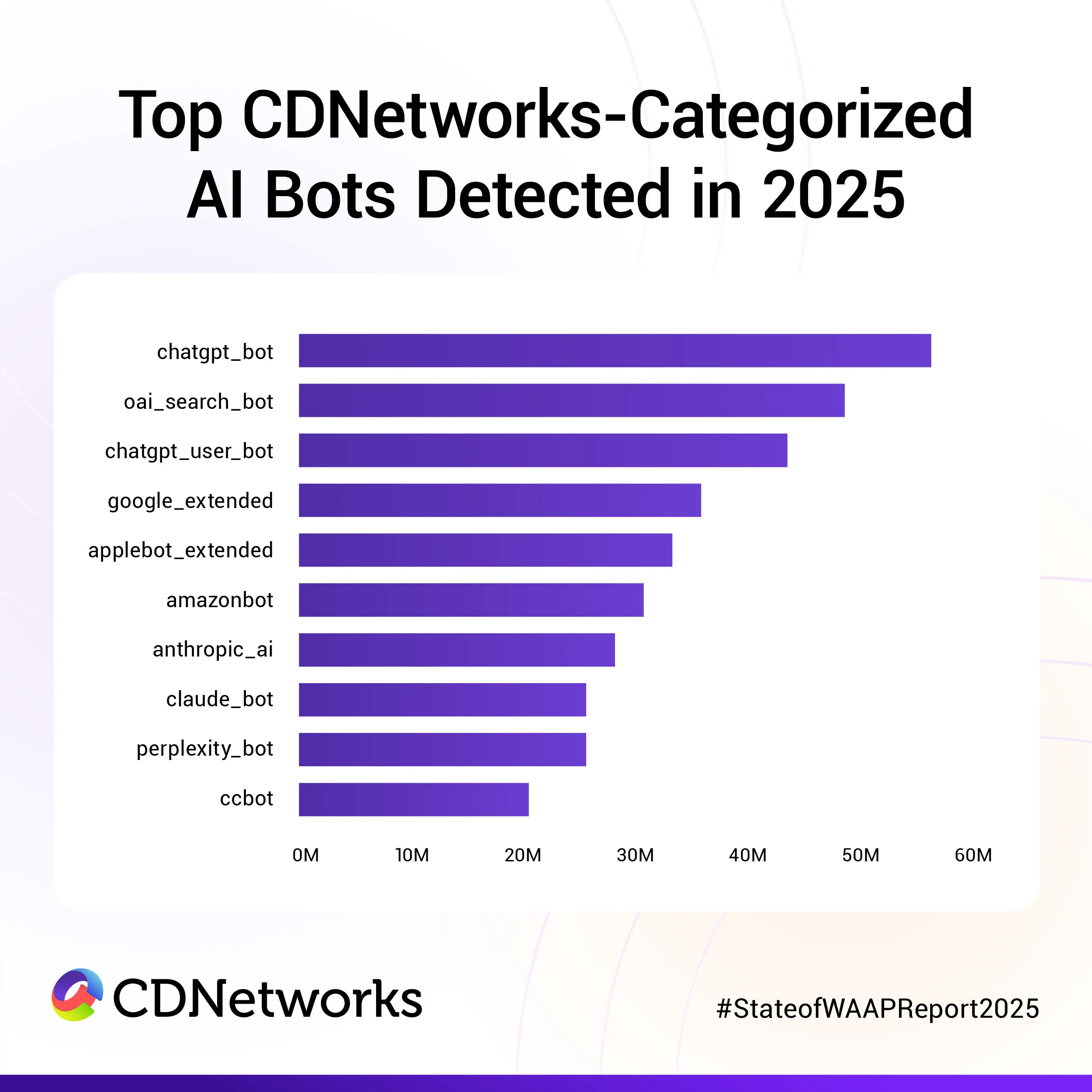
CDNetworks platform observations highlight the most frequently detected AI bot categories in 2025. Bot labels shown reflect CDNetworks traffic classification and may not correspond directly to providers’ official user-agent names.
What are the Business Risks of AI Crawlers?
AI crawlers can provide value through content discovery and AI search visibility, but uncontrolled access can also create business risks.
Content and intellectual property. Large-scale scraping can expose copyrighted, licensed, premium, or proprietary content to collection and reuse beyond its intended context.
Infrastructure costs. Aggressive crawling can consume bandwidth, origin resources, API capacity, and application-processing resources, particularly on dynamic pages.
Traffic quality. Automated requests can complicate analytics and make genuine user demand harder to distinguish from machine-generated traffic.
Visibility versus control. Blanket blocking may reduce exposure in AI-powered discovery, while unrestricted access may provide more access than a business intends.
These trade-offs are especially relevant to publishing and digital-content businesses, where content itself is a commercial asset. In one CDNetworks customer case, a licensed digital content platform blocked more than 10 million malicious crawler requests per day while strengthening protection for copyrighted media assets.
Should You Allow or Block AI Crawlers?
There is no universal allow-or-block policy. A more effective approach evaluates the crawler’s identity, purpose, behavior, target content, and business value.
| Situation | Typical Approach |
|---|---|
| Verified AI search crawler | Allow or monitor |
| AI training crawler | Decide based on content and IP policy |
| User-triggered retrieval | Evaluate business value and target endpoint |
| Legitimate but excessive crawler | Rate-limit |
| Unknown or spoofed automation | Verify, challenge, or restrict |
| Unauthorized scraping | Block |
This approach reflects modern bot management, in which automated traffic is governed by risk and context rather than treated as a single category. CDNetworks’ 2025 findings similarly recommend considering identity, intent, content sensitivity, frequency, and business impact.
How to Detect AI Crawlers
Detection should combine identity signals with behavior.
User-agent identification
Known user-agent strings provide an initial indication of a crawler’s identity, but they should not be treated as proof, as headers can be spoofed.
IP and network verification
Where providers publish network information, IP verification can help confirm legitimate crawler traffic. Perplexity recommends combining user-agent matching with its published IP ranges for stronger verification.
Behavioral analysis
Request frequency, crawl depth, URL patterns, session behavior, header consistency, and repeated access to high-value resources can help identify suspicious or excessive automation.
How to Manage AI Crawlers
Use robots.txt for crawler directives
Robots.txt can communicate access preferences to compliant crawlers. OpenAI and Anthropic both document controls for their crawlers through robots.txt.
Verify known crawlers
Validate user agents and available network information before allowlisting automated traffic.
Apply rate limiting
Legitimate crawlers can still generate excessive requests. Rate limiting can preserve useful access while protecting application and origin resources.
Protect sensitive content and endpoints
Authentication, authorization, WAF rules, and endpoint-specific policies provide stronger controls for content and APIs that should not be openly accessible.
Use behavioral bot controls
Unknown, spoofed, or evasive automation may require behavioral analysis, challenges, risk-based actions, and adaptive enforcement rather than static rules alone.
How CDNetworks Manages AI Crawler Traffic
CDNetworks Bot Shield combines bot identification with behavioral analysis and policy enforcement, allowing organizations to apply different controls according to traffic risk and business intent.
At the edge, organizations can identify known automated traffic, analyze request and session behavior, apply configurable rate limits, and use challenge or blocking mechanisms when activity appears suspicious. Policies can be adjusted according to factors such as source, request path, traffic frequency, and the sensitivity of targeted resources.
This is particularly important for AI crawlers because similar automated requests may represent very different use cases.
A verified AI search crawler supporting discoverability should not necessarily receive the same treatment as an unidentified scraper repeatedly accessing premium content.
By combining visibility, identification, behavioral analysis, rate limiting, and differentiated enforcement, CDNetworks helps organizations maintain legitimate AI-driven discovery while restricting excessive or unauthorized automated access.
Frequently Asked Questions
What is an AI crawler?
AI crawlers are automated bots that discover and retrieve web content for uses such as AI training, search indexing, information retrieval, and AI-generated responses.
Is ChatGPT a web crawler?
ChatGPT is not itself a web crawler. OpenAI operates dedicated crawlers such as OAI-SearchBot for discovering content that may appear in ChatGPT search.
Should I allow AI crawlers?
Access should depend on crawler identity, purpose, content sensitivity, behavior, and business value. Allow useful discovery, restrict unwanted training or scraping, and block abusive automation.
Can robots.txt block AI crawlers?
Robots.txt instructs compliant AI crawlers which content they may access, but stronger controls such as authentication, rate limiting, WAF policies, or bot management may be required for enforced protection.
How can I detect AI crawlers?
Detection combines user-agent analysis, provider verification, IP information, request patterns, crawl behavior, traffic frequency, and session context to distinguish legitimate AI crawlers from spoofed or abusive automation.