Quick Answer: The main difference between WAAP and WAF is the scope of protection. A web application firewall (WAF) inspects HTTP and HTTPS traffic to help block web attacks, including SQL injection and cross-site scripting (XSS). Web Application and API Protection (WAAP) combines WAF capabilities with broader API security, bot management, and DDoS mitigation. A WAF is typically one component of a WAAP solution.
What Is a Web Application Firewall (WAF)?
A WAF is a security control that analyzes application-layer (Layer 7) web requests and applies rules to allow, block, or challenge suspicious traffic. It can run at a CDN edge, as a reverse proxy, or within application infrastructure.
WAFs help defend against common threats such as SQL injection, XSS, and malicious HTTP requests. Modern WAFs can inspect API traffic, and some offer rate limiting, behavioral analysis, and automated threat detection. However, a WAF alone may not provide comprehensive API discovery, specialized bot defense, or multi-layer DDoS mitigation.
What Is Web Application and API Protection (WAAP)?
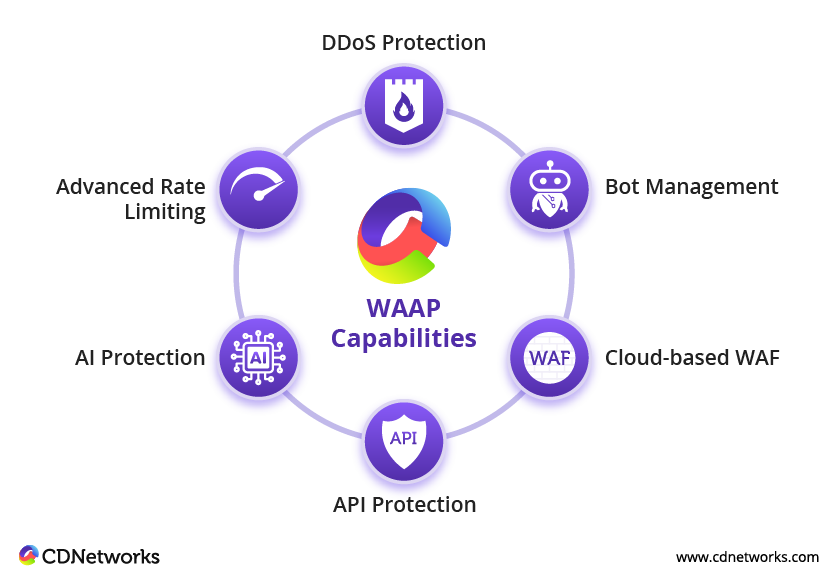
WAAP is an integrated approach to protecting web applications and APIs. It typically brings together four capabilities: WAF, API security, bot management, and DDoS protection.
Beyond filtering malicious requests, WAAP platforms may discover API endpoints, validate requests against API specifications, detect automated abuse, and identify abnormal traffic patterns. Some also use threat intelligence and behavioral analytics to adapt protections across applications and APIs.
WAAP is especially relevant to mobile apps, e-commerce platforms, and microservices architectures, where sensitive business functions are exposed through APIs.
WAAP vs WAF: Key Differences
| Comparison | WAF | WAAP |
|---|---|---|
| Primary Purpose | Filter malicious web requests | Protect web applications and APIs with integrated controls |
| Web Attack Protection | Core capability | Included through WAF |
| API Security | Can inspect API requests; deeper features vary | Typically includes API discovery and specialized controls |
| Bot Protection | May require additional features or products | Typically includes dedicated bot management |
| DDoS Protection | May mitigate some application-layer attacks | Usually integrates application-layer DDoS protection; network-layer coverage varies |
| Management | Focused on WAF policies | Coordinates multiple protections through one platform |
Bottom line: The distinction is about breadth and integration, not whether a WAF can see API requests. Capabilities vary by vendor and product configuration.
Why Does the Difference Matter for API Security?
Consider an online store. A WAF may block an injection attempt against its checkout page. But attackers could also target login APIs with credential-stuffing bots, flood inventory endpoints, or manipulate order identifiers to access another customer’s data.
A WAAP platform can combine WAF filtering, bot detection, endpoint-specific rate limits, and API visibility to address several of these threats together.
However, neither WAF nor WAAP automatically fixes broken object-level authorization (BOLA). The application must verify that each user is permitted to access the requested record. OWASP’s API Security Top 10 identifies broken object-level authorization as an important API risk. Runtime protection complements secure development and testing.
When Should You Choose WAF or WAAP?
Choose a WAF when your primary requirement is to shield a conventional website from common web exploits, your API exposure is limited, and bot or DDoS protection is already handled elsewhere.
Consider WAAP when you operate public-facing APIs, mobile backends, or microservices; face credential stuffing, scraping, or application-layer DDoS attacks; or want unified policies and visibility across several security controls.
Before selecting a platform, review the APIs and applications you expose, attack patterns in your logs, existing safeguards, and operational capacity. If your current WAF already includes API and bot security, compare actual features rather than product labels.
What Should You Look for in a WAAP Solution?
Evaluate whether the service offers:
- API discovery and protection: Inventory endpoints, detect unexpected requests, and apply endpoint-level policies.
- Bot management: Distinguish legitimate automation from scraping, credential stuffing, and abusive traffic.
- DDoS resilience: Mitigate application-layer attacks and clarify whether network-layer protection is included.
- Adaptive detection: Support managed rules, behavioral analysis, and low-friction tuning.
- Operational visibility: Provide centralized logs, alerts, and actionable insights.
Also check deployment compatibility, latency impact, false-positive handling, and how policies integrate with existing development workflows.
How Does CDNetworks Support WAAP?
CDNetworks Cloud Security 2.0 combines WAF, API Security, Bot Management, and DDoS Protection on a cloud-native edge platform. Its AI-powered threat detection and centralized controls help organizations protect web applications and APIs while supporting reliable digital experiences.
Frequently Asked Questions
Does WAAP replace WAF?
WAAP incorporates WAF capabilities into a broader security platform that typically includes API security, bot management, and DDoS protection. Organizations adopting WAAP generally retain WAF functionality as part of the integrated solution.
Can a WAF protect APIs?
Modern WAFs can inspect HTTP-based API traffic and block common threats such as SQL injection and malicious requests. Advanced capabilities like API discovery, schema validation, and API-specific abuse detection depend on the WAF solution.
Is WAAP better than WAF?
WAAP provides broader security coverage by combining WAF, API security, bot management, and DDoS protection. WAF may be sufficient for organizations with limited API exposure and simpler security requirements. The best choice depends on specific threats and infrastructure.
Is WAAP the same as an API gateway?
WAAP focuses on protecting web applications and APIs against cyber threats, while an API gateway manages API routing, authentication, access policies, and traffic. Both solutions can complement each other, although certain capabilities may overlap.
Is WAAP enough to secure an API?
WAAP protects APIs against common attacks, automated abuse, and malicious traffic, but comprehensive API security also requires strong authentication, proper authorization, secure coding practices, regular vulnerability testing, and continuous monitoring.