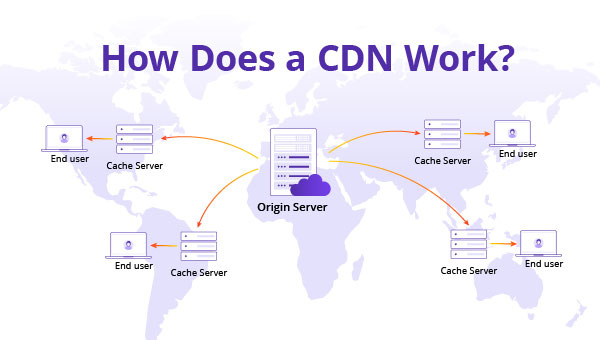
A CDN works by routing user requests to nearby edge servers that can deliver cached content instead of sending every request back to the origin server. When content is already cached at the edge, the CDN serves it immediately. When it is not cached, the CDN retrieves it from the origin, delivers it to the user, and may store a copy for future requests.
This guide explains CDN architecture, request routing, caching, and the performance benefits behind modern content delivery.
What Is a Content Delivery Network?
A CDN is a geographically distributed network of servers that improves web performance by delivering content from locations closer to users.
Instead of serving every request from a single origin server, a CDN routes traffic through nearby edge servers, reducing latency and improving load times.
A CDN accelerates the delivery of websites, applications, media, and other digital content, making it a foundational part of modern internet infrastructure.
Read More: What is a CDN?
How Does a CDN Work?
A CDN works by placing servers closer to users and using those servers to deliver content on behalf of the origin server.
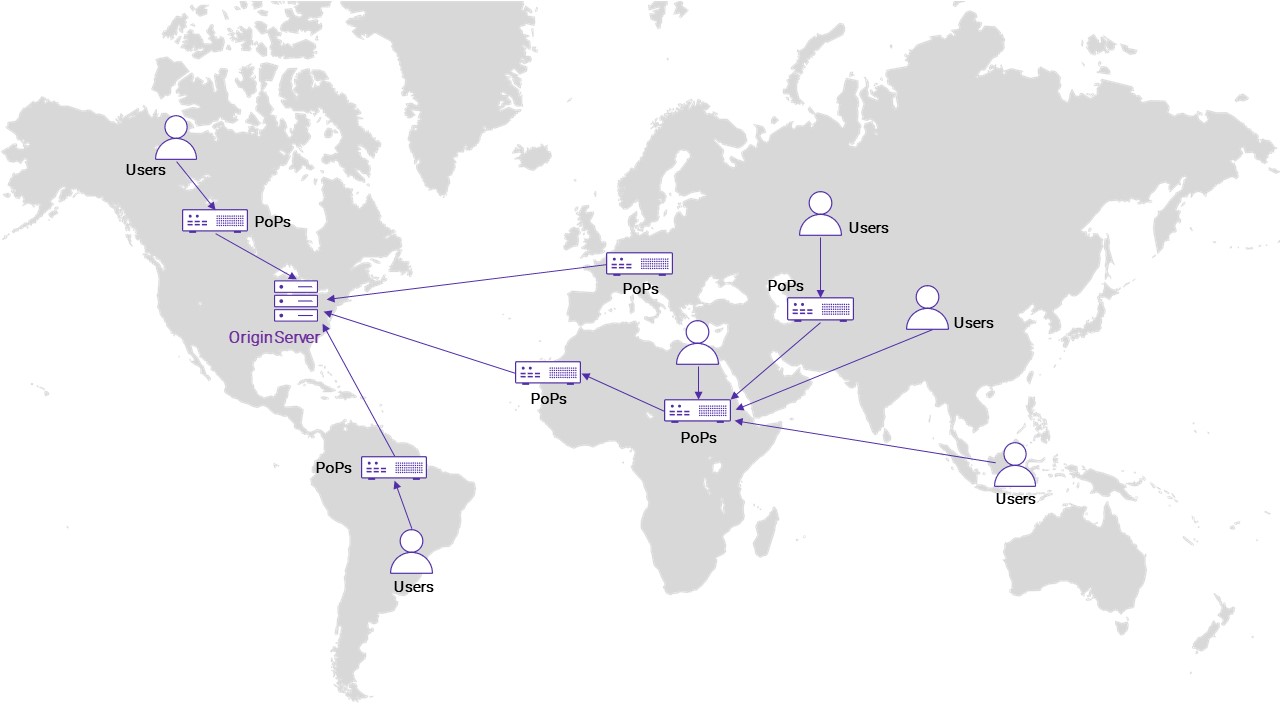
When a user requests content, the CDN determines the best edge location to handle the request. The edge server checks whether the content is available in cache. If a valid cached copy is available, the CDN serves the content immediately.
If the content is not available, the CDN retrieves it from the origin server and may store a copy for future requests. By serving more requests from the edge, a CDN reduces latency, lowers origin server load, and improves delivery performance across different regions.
The next section below will break down each stage of that process in detail.
CDN Request Flow: How Content Is Delivered Step by Step
Understanding the request flow behind a CDN helps connect concepts such as caching, routing, and edge delivery with what happens during an actual user request.
The steps below follow a typical request from the moment a user accesses a website or application to the point where content is delivered.
1. A User Requests a Webpage or Digital Asset
The process begins when a user opens a website, starts a video stream, downloads a file, or accesses an application. The browser sends requests for the resources needed to load the page, which may include HTML files, images, JavaScript, CSS, videos, or application assets.
2. DNS Routes the Request to the CDN
After receiving the request, the Domain Name System (DNS) helps direct the user’s request to the CDN instead of sending every request directly to the origin server.
Routing decisions are typically based on factors such as network conditions, server availability, and the user’s geographic location. Rather than relying on a single delivery point, the CDN can identify a more efficient path for the request before content retrieval begins.
3. The CDN Selects a Nearby PoP or Edge Server
Once the request reaches the CDN, the platform determines which delivery location is best positioned to respond.
Selection is not based solely on geographic proximity. Network congestion, edge server health, capacity, and routing efficiency may all influence the selection process.
4. The Edge Server Checks Whether the Content Is Cached
After the request arrives at the selected edge server, the CDN checks whether the requested content is already available in cache.
Cached content may include images, videos, JavaScript files, CSS files, downloadable assets, and other frequently requested resources. Cache rules determine whether stored content remains valid and can be delivered immediately.
5. A Cache Hit Delivers Content Immediately
When the requested content is found in cache and remains valid, a cache hit occurs.
In this case, the edge server delivers the content directly to the user without contacting the origin server. This shortens the delivery path and reduces origin traffic.
6. A Cache Miss Fetches Content from the Origin Server
A cache miss occurs when the requested content is unavailable, expired, or not eligible to be served from cache.
The CDN forwards the request to the origin server, retrieves the content, and delivers it to the user.
7. The CDN Stores Content Based on Cache Rules
After receiving content from the origin, the CDN may store a copy at the edge according to predefined cache policies.
These rules determine whether the content can be cached, how long it remains valid, and when the CDN should check for an updated version.
8. Future Requests Are Delivered from the Edge
Once content has been cached, subsequent requests can often be served directly from the edge, reducing origin traffic and improving scalability during periods of increased demand.
CDN Architecture: Core Components That Make CDNs Work
A CDN relies on several infrastructure components working together to deliver content efficiently across different regions.
Origin Servers
Origin servers store the original version of website content, application assets, databases, and other resources.
Even when most user requests are served from the CDN, the origin remains the authoritative source of content whenever a cached copy is unavailable or requires updating.
Points of Presence (PoPs)
Points of Presence, commonly called PoPs, are geographically distributed data centers located across different cities, regions, and network hubs.
A PoP extends CDN coverage into a local market, helping place content closer to users. Global CDNs may operate hundreds of PoPs across multiple countries and networks to support low-latency content delivery at scale.
Edge Servers
Edge servers operate within PoPs and handle content delivery requests from users.
Rather than requiring every request to travel back to the origin, edge servers can deliver cached resources directly from the CDN network, reducing unnecessary round trips, and improving delivery efficiency. Edge infrastructure also supports caching, traffic distribution, and content acceleration functions.
DNS Routing
DNS routing systems direct requests to appropriate CDN locations based on factors such as user location, network conditions, and server availability.
Load Balancing
Load balancing distributes requests across available infrastructure instead of concentrating traffic on a single server or location.
Balanced traffic distribution improves resource utilization and helps maintain service availability during periods of elevated demand.
How CDN Caching Works
CDN caching works by storing content at edge locations, so future requests can be served without repeatedly retrieving the same content from the origin server.
When a request reaches the edge, the CDN checks whether a valid cached copy is available. If the content is already cached, it is delivered immediately. If not, the CDN retrieves the content from the origin and may store it for future requests.
CDNs primarily cache static content that remains unchanged across users and requests, including images, CSS files, JavaScript files, fonts, downloadable documents, video files, and static HTML pages.
Dynamic content generated per user or based on real-time data is often less suitable for caching, although modern CDNs can still accelerate dynamic requests through routing and connection optimization.
Cache Hit vs. Cache Miss
A cache hit occurs when the content is available and can be delivered immediately from the edge. A cache miss occurs when no valid copy exists. The CDN retrieves the content from the origin server, delivers it to the user, and stores a copy at the edge. Future requests for the same resource can then be served directly from cache.
TTL and Cache-Control Rules
Cached content does not remain available indefinitely. Time to Live (TTL) determines how long a cached copy remains valid. Once the TTL expires, the CDN retrieves an updated version from the origin before serving future requests.
Cache-Control headers provide additional instructions about whether content can be cached and under what conditions. TTL and Cache-Control policies give teams control over how performance and content freshness are balanced.
CDN vs. No CDN: What Changes in Content Delivery?
The differences between using a CDN and relying solely on an origin server become more apparent as websites, applications, and digital content serve larger audiences across multiple regions.
While caching is one of the most important CDN functions, it is only part of the overall delivery model. Comparing content delivery with and without a CDN helps illustrate the broader impact of CDN infrastructure.
| Category | Without a CDN | With a CDN |
|---|---|---|
| Request Path | Requests go directly to the origin server. | Requests are routed through a nearby CDN PoP or edge server. |
| Latency | Response times are more affected by geographic distance. | Content can be delivered from a location closer to the user. |
| Origin Load | The origin handles all traffic. | The CDN absorbs many repeated requests. |
| Availability | Service depends heavily on origin infrastructure. | Traffic can be distributed across a global network. |
| Traffic Spikes | Sudden demand can overload the origin. | Traffic surges are distributed across the CDN network. |
| Security | Protection is concentrated at the origin. | Security controls can be applied across the network edge. |
| Global User Experience | Performance varies by region. | Performance remains more consistent across regions. |
A CDN does not replace the origin server. Instead, it adds a distributed delivery layer that helps store content, route requests, and manage traffic more efficiently across different locations.
What Is the Role of a CDN in Web Performance?
A CDN improves web performance by serving content from edge servers closer to users, reducing network round trips, lowering latency, and offloading repeated requests from the origin. It also distributes traffic across multiple locations, helping websites maintain consistent performance during traffic spikes and regional network congestion.
CDN also improves availability and supports global scalability without concentrating demand on the origin. For large assets such as video files, software downloads, and high-resolution images, edge delivery can significantly improve user experience across regions.
When Does a Business Need a CDN?
Not every website requires a CDN. A business may need a CDN when website traffic, user locations, content size, or performance requirements outgrow a single-origin delivery model.
A CDN is often valuable when:
- Users are distributed across multiple countries or regions
- Websites or applications deliver large files, visual content such as video and images, or software downloads
- Applications require consistent performance across geographically diverse user bases
- Traffic spikes occur during promotions of products or services, product launches, live events, or seasonal demand peaks
- Higher availability, stronger security, or lower origin server load becomes a priority
Organizations often adopt a CDN when several of these requirements exist at the same time.
What Are the Business Benefits of Using a CDN?
The technical benefits of a CDN often support measurable business outcomes.
Faster, more consistent content delivery supports better user engagement, while distributed infrastructure improves reliability and service availability.
CDN security capabilities can also help protect websites and applications through DDoS protection, web application firewall controls, bot mitigation, and traffic filtering.
For organizations serving multiple markets, a CDN can support regional performance, access control, compliance needs, and more reliable content delivery.
How CDNetworks Supports Global Content Delivery
Effective content delivery depends on global infrastructure, caching efficiency, traffic optimization, and edge security.
CDNetworks supports those requirements through:
-
Global PoP coverage: More than 3,000 CDN PoPs across 90+ countries and regions help deliver content closer to users worldwide.
-
Intelligent caching: Configurable cache policies and hierarchical caching help improve cache efficiency and reduce origin server load.
-
Dynamic acceleration: Route optimization and acceleration technologies help improve delivery performance for dynamic applications and non-cacheable content.
-
Security capabilities: Integrated DDoS protection, web application firewall (WAF), and traffic filtering help protect applications at the network edge.
Learn more about how CDNetworks helps organizations accelerate and secure global content delivery.
Content Delivery Network FAQs
How does a CDN work step by step?
A CDN routes user requests to an appropriate edge location, serves cached content when available, and retrieves content from the origin when necessary.
What is the difference between an origin server and an edge server?
The origin server stores the original version of content and applications. Edge servers store cached copies and deliver content closer to users.
What happens when a CDN does not have cached content?
When requested content is not available at the edge, the CDN retrieves the content from the origin server, delivers it to the user, and may store a copy for future requests based on cache policies.
Is a CDN just a cache?
Caching is one function of a CDN. Modern content delivery networks also provide traffic management, load balancing, security services, and application acceleration capabilities. A CDN’s role extends well beyond caching.
How does a CDN improve web performance?
A CDN reduces latency by shortening the distance between users and content. Edge caching also reduces origin server load and helps maintain performance during periods of high demand.
How does a CDN choose an edge server?
CDNs use factors such as proximity, network conditions, and server availability to select an appropriate delivery location.