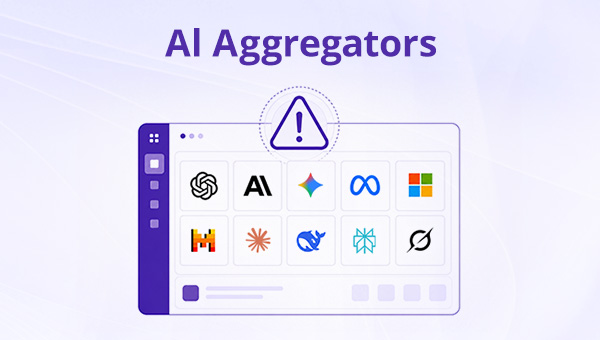
AI aggregators are changing how organizations and individuals access advanced AI capabilities. Instead of juggling multiple subscriptions and APIs, users can now access leading models through a single AI aggregator platform. The demand for these all-in-one AI solutions has surged as organizations move from experimentation to production use of multi-model AI.
In this article, we’ll explore what an AI aggregator is, how it works, its core features and benefits, the challenges it faces, and practical ways to overcome them.
What Is an AI Aggregator?
An AI aggregator, multi-model AI platform, or all-in-one AI platform, consolidates multiple AI models into one unified platform.
Think of it as a universal remote for AI, where one interface gives users access to multiple models.
Instead of switching between separate tools, users access multiple models through a single interface and choose the most suitable one for each task. For example, someone might use ChatGPT for writing, Claude for long-document analysis, and Perplexity for web research, all within the same interface.
How an AI Aggregator Works
AI aggregators operate through three core steps: receive, route, and return.
-
Receive: Users submit prompts through the AI aggregator interface. Modern platforms support multimodal inputs—text, images, audio, and files—depending on each model’s capabilities. A user might upload an image for Gemini to analyze, then switch to Claude for text reasoning.
-
Route: The AI aggregator forwards each request to the selected model’s API. Authentication, rate limits, and error handling happen behind the scenes. Whether generating images with DALL-E or processing documents with GPT-4, users never manage API connections directly.
-
Return: Responses flow back through the aggregator to the same chat window. Some platforms format outputs, cache frequent queries, or let users compare results from multiple models side by side.
In short, users interact with one interface while the aggregator handles every backend connection, routing request and response through a single pipeline.
Key Benefits of AI Aggregators
Use the Best AI Model for Each Task
An AI aggregator connects multiple AI models within one interface, including options like ChatGPT, Claude, and Gemini. Users can select the most suitable model for each task, from writing to coding to research papers. This flexibility improves output quality while reducing dependence on a single provider.
Manage AI Workflows in One Place
Users can manage conversations, prompts, and outputs through one interface without switching between platforms. Many AI aggregators also support side-by-side model comparisons to evaluate differences in accuracy, tone, and reasoning.
Work Across Multimodal Contents Efficiently
Many AI aggregator platforms extend beyond text to support file analysis and image generation within one interface. Integrated capabilities reduce tool fragmentation and streamline workflows across different content types.
Track AI Usage and Costs More Easily
Separate AI platforms often lead to duplicated subscriptions and fragmented billing. An AI aggregator consolidates access and usage into one system. Teams gain better cost visibility while maintaining flexibility across different models.
Multi-Model AI Platforms vs. Single-Model AI Platforms
A multi-model AI setup offers more flexibility than relying on a single model. The differences become clear in daily workflows.
| Capability | Multi-Model AI Platform | Single-Model AI Platform |
|---|---|---|
| Model Selection | Choose different AI models based on the task | Rely on one model for all tasks |
| Workflow Management | Access multiple models through one unified interface | Switch between separate tools and accounts |
| Output Comparison | Compare responses from different models side by side | No direct model comparison |
| Vendor Dependency | Reduce reliance on a single AI provider | Locked into one provider’s ecosystem |
| Cost | Consolidated and easy to track | Separate billing and hard to manage |
AI aggregators offer clear advantages in flexibility and efficiency — but scaling them in production introduces a new set of operational challenges.
Five Critical Challenges of AI Aggregators
AI aggregators consolidate access to multiple models but operating them at scale introduces significant infrastructure complexity. Serving diverse workloads across regions and providers creates pressures that single-model deployments never face. The following five critical challenges define where AI aggregator infrastructure is most likely to break down.
1. Integration and Compatibility Issues
Connecting multiple AI models requires handling different APIs, data formats, and authentication methods. Compatibility issues become more difficult when model vendors introduce version updates or API changes without notice.
As integration expand, maintaining stable connections across models and internal systems requires continuous adjustments. Engineering teams must constantly monitor upstream changes, update integrations, and ensure stability across workflows. Complexity increases even further as multi-model AI platforms scale across more models, APIs, and user environments.
2. Distributed Delivery Increases Latency and Regional Instability
AI aggregators often serve users across multiple regions while relying on geographically distributed AI providers. Long transmission paths and regional network congestion can increase latency, especially for real-time AI interactions.
These performance issues become more noticeable during streaming outputs, file uploads, and long-context reasoning tasks that require stable and responsive delivery. Maintaining stable cross-region traffic flow becomes increasingly difficult as AI usage expands globally.
3. Unpredictable Traffic Spikes Threaten Service Availability
AI aggregators often experience unpredictable usage growth as adoption expands across teams, applications, and regions. Traffic demand can change rapidly, making it difficult to maintain stable platform performance during periods of increased activity.
As more users interact with multiple AI models simultaneously, maintaining a consistent service experience becomes increasingly challenging. Delays, unstable responsiveness, and temporary service disruptions can all impact user satisfaction and operational reliability.
4. Distributed API Exposure Creates Security and Privacy Risks
AI aggregators depend heavily on external APIs, which increases exposure at the network layer. Requests and responses often travel across regions and third-party infrastructure.
As AI requests move across regions and external APIs, protecting data in transit becomes more challenging. API endpoints must be protected from abuse, while sensitive data needs consistent protection across distributed environments. Security management grows even more complex as traffic flows expand and API exposure increase at scale.
5. Multi-Provider Pricing Makes Cost Management Difficult
Managing costs across multiple AI models can quickly become complicated. Different AI providers use different pricing structures based on tokens, requests, compute usage, or API calls, making spending harder to predict and control.
Cost management becomes even more difficult when AI aggregators dynamically route requests across multiple models. Poor routing decisions, inefficient model selection, or uncontrolled usage can rapidly increase costs without clear visibility into what is driving overall spending.
How to Overcome AI Aggregator Challenges?
Although the mentioned challenges appear across different areas, many share the same underlying issue: delivering AI services reliably across distributed environments. Maintaining stability at scale depends on network efficiency, traffic management, API governance, and a resilient global delivery architecture.
At CDNetworks. we provide the global acceleration and security AI aggregators need to maintain performance, availability, and protection as demand grows.
1. Simplify Integration Through a Stable Delivery Layer
Supporting multiple AI providers often creates ongoing operational friction behind the interface layer. Differences in API structures, authentication mechanisms, and release cycles increase the amount of coordination required to keep services functioning consistently across environments.
The complexity grows further when platforms support multimodal interactions, persistent chat sessions, or enterprise-scale workflows involving multiple routing paths. Engineering teams may spend significant time adapting to upstream changes instead of improving product functionality.
To reduce maintenance overhead, many multi-model AI platforms introduce an intermediary delivery layer that standardizes traffic handling and isolates backend dependencies from user-facing applications. A more controlled request architecture improves service consistency while reducing the operational impact of provider-side changes.
2. Improve Global Performance and Reliability
AI inference traffic often crosses multiple geographic regions before reaching the destination model. As platforms expand internationally, long transmission paths and regional congestion can gradually affect response speed, especially for real-time AI interactions.
AI aggregators typically address these challenges through edge acceleration, protocol optimization, and intelligent routing strategies designed to reduce unnecessary network overhead and improve transmission efficiency.
CDNetworks improves delivery performance through a global network of 3,000+ PoPs. Support for HTTP/2, HTTP/3 (QUIC), and WebSocket ensures efficient transmission. Intelligent traffic steering via Anycast and Global Server Load Balancing (GSLB) routes requests to the optimal edge, reducing cross-region latency and improving response speed.
3. Maintain High Availability Under Traffic Spikes
Unlike conventional web applications, AI workloads are resource-intensive by nature. Product launches, viral adoption, and automated pipelines can drive sudden spikes in concurrent requests, while long-running inference tasks place sustained pressure on origin infrastructure. Standard scaling approaches are often too slow to absorb these conditions before service quality degrades. Maintaining availability therefore requires distributed traffic handling, edge offloading, and rapid failover mechanisms capable of responding in real time.
CDNetworks helps distribute traffic at the edge through its Dynamic Web Acceleration by intelligent load balancing and real-time queue control. Continuous network monitoring and instant failover capabilities improve platform resilience while supporting high-concurrency AI workloads.
4. Strengthen Security and Data Protection
AI aggregators operate across highly distributed environments that involve external APIs, user-generated content, and cross-platform data exchange. As requests move between users, aggregation platforms, and model providers, maintaining visibility and control over traffic flows becomes increasingly important.
Operational risks extend beyond direct attacks. Unauthorized API consumption, credential misuse, abnormal request behavior, and automated abuse can all impact service reliability and expose sensitive information.
Securing AI delivery infrastructure typically requires layered protection across both network and application layers. Traffic filtering, API governance, encryption, and access control mechanisms help reduce exposure while maintaining secure communication between distributed services.
CDNetworks’ Cloud Security 2.0 provides integrated DDoS mitigation, WAF protection, bot mitigation and API security to help reduce malicious activity and prevent abuse. Origin IP masking and secure traffic management further strengthen backend protection across distributed AI environments.
5. Optimize Cost Through Efficient Delivery
As AI usage scales, infrastructure efficiency becomes an increasingly important factor in operational cost management of AI aggregators. Although model inference and token consumption represent major expenses, inefficient traffic delivery can also create unnecessary resource consumption across origin infrastructure and network bandwidth.
To improve efficiency, many large-scale AI aggregators adopt edge caching, intelligent traffic separation, and optimized content delivery strategies. Reducing redundant origin requests helps lower bandwidth usage while improving infrastructure utilization.
CDNetworks supports cost optimization through intelligent separation of static and dynamic traffic. Static assets are cached at the edge, while dynamic AI requests are routed efficiently to origin infrastructure. The approach reduces origin load, improves bandwidth efficiency, and helps maintain more predictable operational costs as platform demand grows.
AI Aggregators FAQs
What Is an Aggregator in AI?
AI aggregators unite multiple AI models under a single interface, letting users access GPT-4, Claude, Gemini, and others without switching platforms. They route requests to the most suitable model based on task type, cost, or performance requirements.
What’s the Difference Between Multimodal AI and Multi-Model AI?
Multimodal refers to one model handling multiple input types — text, images, and audio. Multi-model means orchestrating several distinct AI models together. A single multimodal model processes diverse data; a multi-model system selects the best specialized model per task.
What Are the Core Benefits of AI Aggregators?
Consolidating access to multiple models reduces vendor lock-in, cuts costs through competitive routing, and accelerates workflows. Teams gain flexibility to benchmark outputs, fallback to alternatives during outages, and match each task to the strongest available model.
Is AI Aggregator Safe?
Safety depends entirely on the provider’s data handling policies. Reputable AI aggregators enforce encryption, access controls, and clear data retention rules. Users should audit whether prompts are logged, stored, or used for training before trusting sensitive workloads to any AI aggregators.