AI aggregators, also known as multi-model AI platforms, give users access to multiple AI models such as ChatGPT, Claude, and Gemini through a single interface, eliminating the need to manage separate accounts, integrations, and switching costs.
As multi-model AI platforms scale, infrastructure quickly becomes the limiting factor. Cross-region latency, traffic surges, and API security risks are not just performance inconveniences. They can ultimately limit how far a platform is able to grow.
In this article, we’ll explore two infrastructure priorities that become increasingly important as AI aggregators scale: global edge acceleration and API security. We’ll also examine how CDNetworks helps address both.
The Infrastructure Challenges AI Aggregators Face as They Scale
Scaling an AI aggregator introduces two major infrastructure challenges: maintaining consistent performance across an increasingly complex model-routing layer and securing a growing number of public-facing APIs. As platforms expand across providers, regions, and AI services, both challenges become more difficult to manage and can directly affect user experience, operational efficiency, and long-term scalability.
1. Performance Variability Across Providers and Regions
Consistent performance becomes harder to maintain as platforms grow. A user request does not always travel to a single model in a single location. Depending on availability, cost, and routing logic, traffic may pass through multiple providers, regions, and network paths before reaching GPT-5, Claude, or another model. As more models, workflows, and user locations are added, routing decisions become more frequent and more complex. Different providers and regions can introduce variations in latency, availability, and response quality, making it increasingly difficult to deliver a consistent user experience across the platform.
2. API Abuse and Security Exposure at Scale
Beyond performance management, security becomes increasingly challenging as AI aggregators expose more APIs and handle larger volumes of traffic. Public endpoints are frequent targets for unauthorized access, automated scraping, and malicious requests. Abuse can consume model resources, increase inference costs, and degrade operational efficiency long before application availability is affected. As usage grows, the attack surface expands, increasing the complexity and operational burden of monitoring, access control, and threat mitigation.
Addressing these challenges is essential not only for maintaining a reliable user experience but also for controlling infrastructure and model-serving costs, protecting platform resources, and supporting sustainable long-term growth.
How to Deliver Multi-Model AI Traffic Faster Across Regions
Performance challenges in AI aggregators rarely originate from model inference alone. Within a typical AI workflow, a single request submitted through unified APIs may be routed to different providers depending on model selection, availability, pricing, or workload distribution. Each routing decision adds complexity to the delivery path and increases exposure to network variability.
That means adding more compute capacity will not necessarily fix the latency introduced by multi-model routing. Fast and consistent delivery depends just as much on network efficiency as it does on compute capacity.
Shortening the Request Path Across Regions and AI Providers
Latency accumulates at every boundary a request crosses: between regions, between providers, and at each network handoff. Public internet routes are rarely optimized for this traffic pattern, leaving response times exposed to congestion, inefficient routing, and jitter.
Reducing latency starts with placing network entry points closer to users. Edge PoPs terminate requests nearby and route traffic along paths selected in real time based on network conditions. For long-distance transmission, private backbone networks replace unpredictable public routes with dedicated connections that hold consistent performance under congestion.
Shorter transmission paths and stable routing reduce time to first token and keep response times consistent. The gains in response consistency and time-to-first-token become more noticeable as AI aggregator platforms expand across regions and handle higher request volumes.
Routing efficiency is only part of the performance challenge. As traffic volumes grow, platforms must also maintain service stability under unpredictable demand.
Absorbing Traffic Spikes Without Overloading Origin Infrastructure
AI aggregator traffic is inherently unpredictable. A new model release or a sudden spike in user activity can push request volumes from normal to extreme within minutes.
High concurrency puts direct pressure on origin servers: more simultaneous connections mean longer processing queues and faster resource exhaustion. For AI aggregators, streaming responses compound the problem. Token-by-token delivery requires the connection to stay open and stable for the full duration of a response. Network congestion or origin overload at any point breaks the stream mid-output.
Handling peak traffic without degrading response quality requires infrastructure that can absorb request volume before pressure reaches the origin. Beyond raw capacity, streaming responses demand stable, long-lived connections that hold up from the first token to the last.
Multi-model AI platforms that can absorb volume at the edge and maintain connection stability from end to end are the ones built to scale without compromising the user experience.
Addressing these challenges requires infrastructure that improves routing efficiency, absorbs traffic spikes, and maintains stable connections across long-distance delivery paths.
How CDNetworks Improves Al Delivery Speed and Resilience
CDNetworks addresses the two core delivery challenges AI aggregators face as platforms expand through Dynamic Web Acceleration and a strong global network built to handle the demands of real-time AI traffic.
- Global Reach and Intelligent Routing
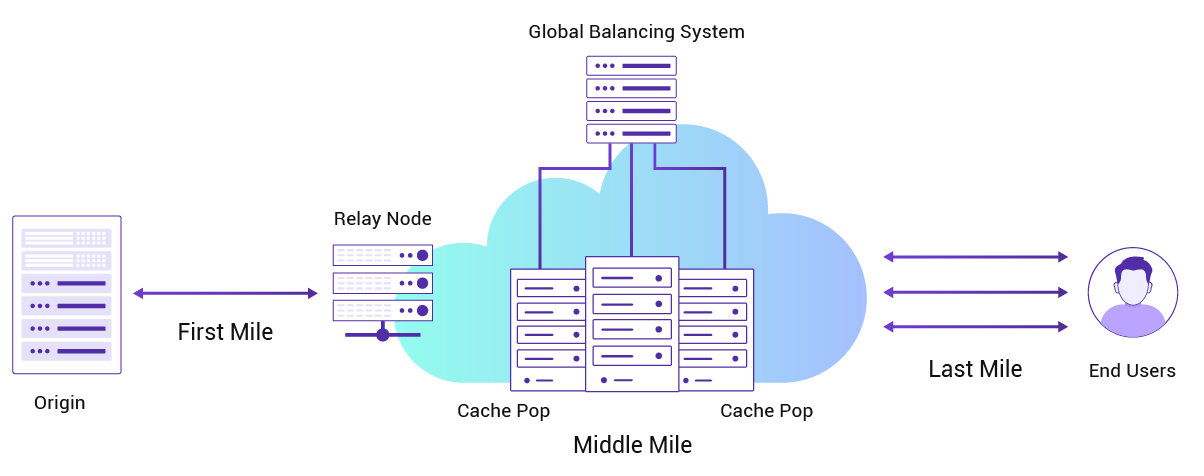
Keeping requests fast across long distances starts with getting them off the public internet as early as possible. CDNetworks leverages 3,000+ PoPs across 90+ countries, backed by over 200 Tbps of network capacity. Anycast and GSLB route each request to the nearest edge location, cutting exposure to public internet congestion. Where long-distance transmission is unavoidable, private backbone connectivity takes over, replacing unpredictable public routes with dedicated paths that hold performance under load.
- Optimized Delivery for AI API Traffic
Unlike static content, AI API requests cannot be cached and must be processed end to end every time. Any transmission delay adds directly to how long users wait for a response in the chat window. Dynamic Web Acceleration closes that gap by keeping connections warm across the middle mile, improving data transfer under congested conditions, and handling encryption overhead at the edge rather than burdening origin servers. The result is faster, more consistent API response times without requiring any changes on the application side.
- Traffic Resilience During Peak Demand
When request volumes spike, a virtual waiting room controls inbound traffic flow, releasing requests at a managed rate that protects origin infrastructure from overload. Real-time monitoring and automatic failover maintain service continuity when network conditions shift unexpectedly.
- China Market Access
For AI aggregators serving users in Mainland China, CDNetworks delivers latency below 50ms with full regulatory compliance and no ICP filing required. Multi-model AI platforms can extend access to users in China without building a separate infrastructure stack.
How to Secure Public AI APIs at Scale
Delivery performance alone is not enough to support sustainable growth. As AI aggregators attract more users and expose more public APIs, security risks grow alongside traffic volume.
Unlike traditional web applications, many AI aggregators operate on usage-based pricing. Every request consumes model resources, generates token costs, and places additional load on backend infrastructure. Unchecked abuse therefore drives up operating expenses and degrades service availability for legitimate users at the same time.
Stopping malicious traffic at the edge helps platforms scale without exposing infrastructure to unnecessary risk.
Stopping APl Abuse Before lt Drains Your LLM Budget
Most API abuse does not begin with large-scale attacks. Stolen credentials, automated scripts, and unauthorized access to exposed endpoints are far more common entry points. A single compromised API key can generate thousands of requests before abnormal usage patterns become visible.
For AI aggregators on usage-based pricing, financial exposure is direct. Every abusive request consumes paid model capacity regardless of its origin, and costs accumulate across multiple providers simultaneously. By the time platform operators identify the abusive source or compromised credential, the damage is already reflected in the bill.
Edge-based controls intercept abuse before requests reach model providers:
- Behavioral analysis identifies abnormal request patterns that static rules miss.
- API rate limiting caps usage per credential, preventing runaway consumption from a single compromised key.
- Access controls restrict endpoint exposure to verified sources before traffic enters the delivery pipeline.
Intercepting abuse at the edge keeps token consumption under control and preserves model capacity for legitimate users.
Blocking Bots, DDoS Attacks, and Direct-to-Origin Threats
Beyond API abuse, AI aggregators face a broader set of threats targeting their public-facing endpoints directly. Malicious bots, credential stuffing, and volumetric attacks all exploit the same surface: APIs that need to remain accessible to function.
Modern bots rarely behave like traditional automation. Many mimic normal user activity, rotate identities, and distribute requests across large IP ranges, making rule-based filtering unreliable on its own. Meanwhile, exposed origin IP addresses create a separate risk: direct attacks that bypass application-level protections entirely.
Mitigating automated abuse and direct-to-origin attacks requires controls that operate at different layers:
- Bot management detects automated activity through behavioral signals rather than static signatures, reducing false positives without blocking legitimate traffic.
- Origin shielding hides backend infrastructure from public exposure, removing the attack surface that direct-to-origin attacks depend on.
- DDoS scrubbing absorbs volumetric attacks and filters malicious requests at the network edge before they reach origin servers.
Together, bot mitigation, origin shielding, and DDoS protection help maintain stable access to AI services even during periods of elevated threat activity.
How CDNetworks Stops API Abuse, Bots, and DDoS Attacks at the Edge
API abuse, malicious bots, DDoS attacks, and origin exposure rarely occur in isolation. Addressing each threat with a separate AI tool creates visibility gaps and operational overhead that grow harder to manage as traffic scales.
CDNetworks addresses acceleration and security within a single platform, handling both legitimate and malicious traffic at the edge before requests reach upstream AI model providers.
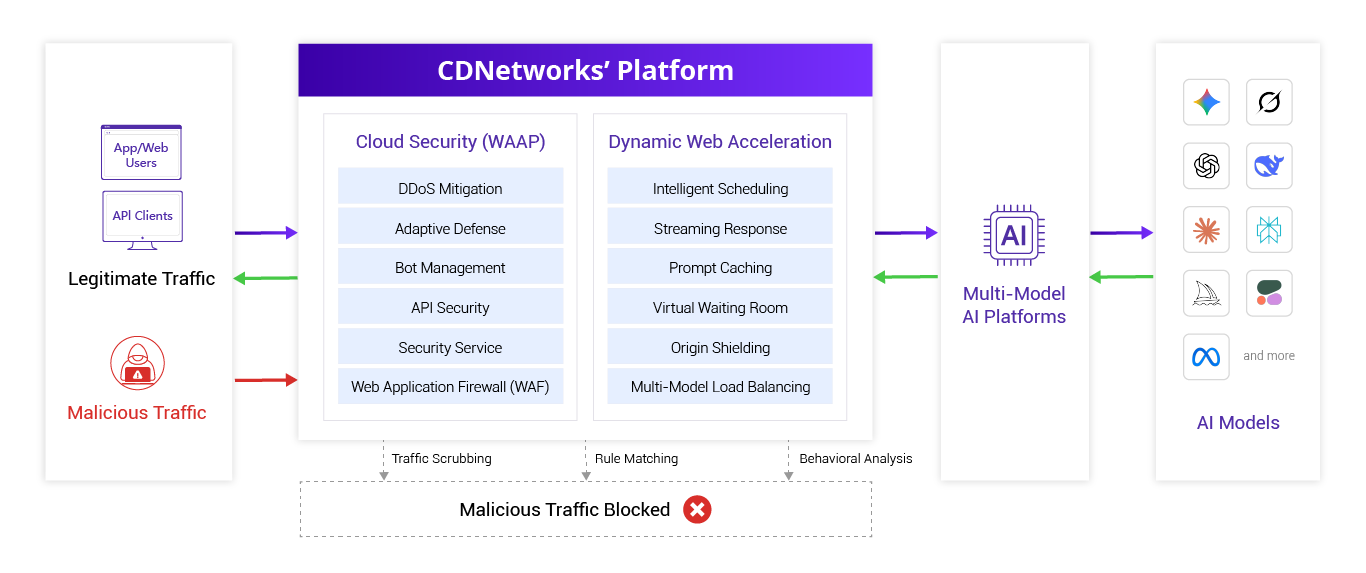
As the architecture illustrates above, Cloud Security 2.0 and Security Services form the security layer within our platform, enforcing protection policies at a single inspection point before requests reach origin infrastructure, keeping coverage consistent across all entry points without adding latency or operational complexity.
Within Cloud Security 2.0, three key features are particularly relevant for AI aggregators facing API abuse, automated scraping, and infrastructure exposure:
-
AI API rate limiting and access control cap usage per credential and restrict endpoint exposure, preventing stolen keys or abusive scripts from draining model budgets before the activity is detected.
-
Bot management identifies automated traffic through behavioral analysis rather than static rules, blocking scraping and credential abuse without disrupting legitimate users.
-
DDoS mitigation with integrated WAF and origin shielding absorbs volumetric attacks at the network edge while keeping backend infrastructure hidden from direct exposure.
Security enforcement and traffic acceleration share the same edge infrastructure, allowing protection policies to be applied without introducing additional latency.
Together, these capabilities help AI aggregators control infrastructure costs, reduce abuse, and maintain service availability.
Scaling AI Aggregators with CDNetworks
As competition among AI aggregators intensifies, infrastructure increasingly becomes a differentiator rather than a supporting component. Platforms that can deliver low-latency access while protecting APIs from abuse are better positioned to expand globally, control operating costs, and maintain a consistent user experience.
CDNetworks provides an integrated acceleration and security solution designed for the unique demands of multi-model AI platforms. By combining Dynamic Web Acceleration, Cloud Security 2.0, and Security Services, our solution has helped a global multi-model AI platform reduce latency by more than 70% and lower origin bandwidth consumption by more than 66%.
For AI aggregators ready to expand globally, the infrastructure foundation matters from the start. Talk to our experts today or request a free trial to see how CDNetworks can support your growth.