Finding the best CDN for video streaming depends on more than network size. Live streaming requires low latency, consistent playback, rapid scalability, and reliable performance during traffic spikes. Different CDN providers excel in different areas, from global reach and edge delivery to security and real-time streaming optimization.
This guide compares five leading providers for 2026, explains how CDN services and a Content Delivery Network (CDN) supports live streaming, and highlights the factors that matter when selecting the right solution.
What Is a Live Streaming CDN
A live streaming CDN is a specialized content delivery network tailored for delivering video content to viewers more efficiently and reliably. Instead of depending on a single delivery point, the network distributes streaming traffic across multiple locations to improve scalability and maintain a high-quality viewing experience. Live streaming CDNs are widely used by broadcasters, media platforms, sports organizations, online education providers, and businesses hosting live events.
How CDN Works for Live Streaming
A live streaming CDN improves video delivery by moving content closer to viewers. Instead of sending every video request directly to the origin server, the CDN distributes live streams to large audiences across a distributed network of geographically positioned edge servers. Viewers can then receive video from the nearest available edge location, reducing the distance data travels and improving playback performance.
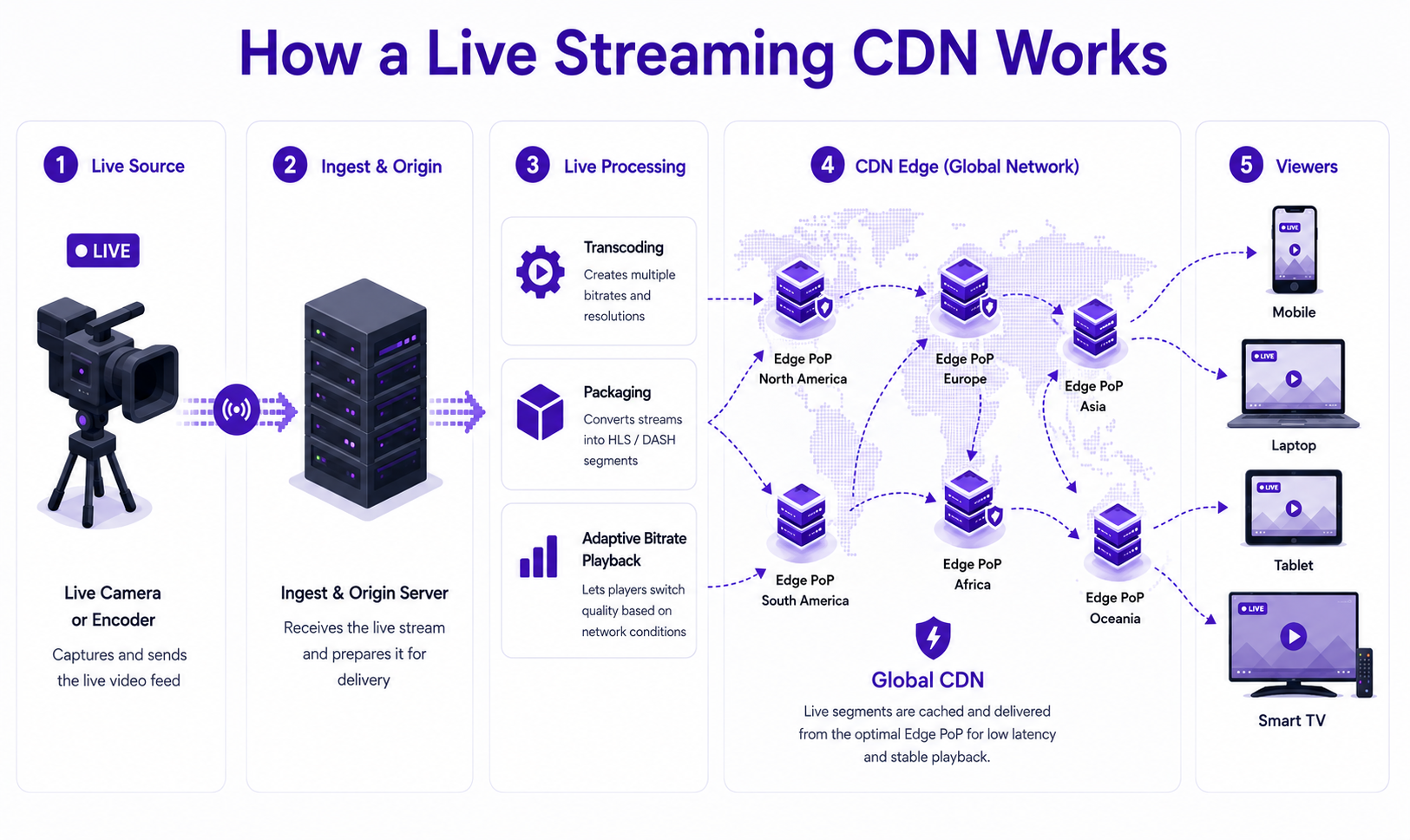
By optimizing the delivery path and balancing traffic across multiple edge locations, a streaming CDN helps reduce latency, minimize buffering, and maintain stable video quality during high-demand events.
For standard live streaming, optimized CDN delivery can typically achieve end-to-end latency below five seconds, while ultra-low latency streaming can reach sub-second performance when combined with protocols such as WebRTC and the right streaming infrastructure.
Why Use a Live Streaming CDN? Benefits & Common Use Cases
A live streaming CDN helps deliver faster, more reliable streaming experiences while supporting audience growth and reducing infrastructure pressure.
Here is a closer look at the key features and core benefits of integrating a CDN and the common use cases that rely on live streaming CDNs.
Key Benefits
- Improved playback quality: Deliver smoother viewing experiences with fewer interruptions and less buffering.
- Seamless scalability: Support massive, concurrent audiences during live events without sacrificing stream performance.
- Lower infrastructure costs: Drastically reduce bandwidth expenses by offloading egress traffic from your origin server.
- High service reliability: Prevent origin crashes and maintain uptime during sudden traffic spikes and peak events.
- Expanded global reach: Ensure consistent, high-quality video performance for viewers across different countries and regions.
Common Use Cases
- Sports & esports live broadcasts
- OTT & media streaming platforms
- Live commerce and interactive product launches
- Online education and virtual classrooms
- Gaming tournaments and live gameplay streaming
How We Evaluated the Best Live Streaming CDNs
No single CDN is the best fit for every streaming platform.
To help you find the best CDN for live streaming, we evaluated each provider based on the capabilities that have the greatest impact on live streaming performance, scalability, and operational reliability.
We focused our evaluation on six core pillars:
1. Global edge network: We assessed the size and geographic distribution of each edge network because broader coverage reduces latency and delivers a more consistent viewing experience for global audiences.
2. Live streaming performance: We evaluated streaming performance based on latency, playback stability, and the ability to deliver high-quality video under changing network conditions.
3. Scalability: We considered how well each provider handles sudden traffic spikes because live events can attract thousands or even millions of concurrent viewers within minutes.
4. Origin offload efficiency: We compare how effectively each CDN reduces requests to the origin server, helping improve reliability while lowering infrastructure costs.
5. Security and availability: We examined built-in security capabilities and network resilience because DDoS attacks, malicious traffic, and service disruptions can interrupt live broadcasts.
6. Ease of integration: We reviewed deployment flexibility, API support, and compatibility with common streaming workflows and protocols, including RTMP, FLV, HLS, DASH, and WebRTC, because seamless integration helps teams deliver content efficiently across different devices and streaming scenarios.
5 Best CDN Providers for Live Streaming
Many CDN providers support live streaming, but only a few can consistently deliver the low latency, scalability, and reliability required for high-quality streaming experiences.
Based on the evaluation criteria above, the following providers stand out for different streaming scenarios, from global media platforms to enterprise broadcasts and regional delivery across Asia.
Quick Recommendations
Choose a provider based on your highest-priority requirements:
- CDNetworks for global live streaming with an Asia performance advantage, integrated security, and enterprise-grade scalability.
- Akamai for large-scale enterprise media delivery and proven global reliability.
- Cloudflare for developer-friendly streaming with integrated networking and security.
- Fastly for ultra low latency streaming and programmable edge capabilities.
- AWS for streaming workflows built on AWS services.
Comparison of Best CDN for Live Streaming
| Provider | Global Coverage | Best For | Supported Streaming Protocols | Indicative End-to-End Latency* | Security Capabilities | Scalability & Reliability |
|---|---|---|---|---|---|---|
| CDNetworks | 3,000+ PoPs across 90+ countries with leading coverage in APAC | Media, OTT, gaming, live commerce, enterprise live streaming | RTMP, FLV, HLS, DASH, SRT, CMAF, WebRTC, QUIC | <500 ms (WebRTC) | Integrated DDoS, WAF, Bot Management, and API Security | 200+ Tbps network capacity with proven global scalability for high-concurrency live streaming |
| Akamai | Extensive global edge network | Large-scale broadcasting, OTT platforms, and media enterprises | HLS, DASH, CMAF | 2–5 s (LL-HLS · CMAF/fMP4) |
DDoS Protection, WAF, API Security, Zero Trust | Proven scalability for enterprise-scale streaming |
| Cloudflare | Large global edge network | Interactive live apps, UGC video platforms, developer-driven streaming services, and modern web applications | HLS, LL-HLS, WebRTC | <1 s (WebRTC · Beta) |
DDoS, WAF, Zero Trust | Highly scalable |
| Fastly | Global network covering major cities | Interactive live streaming, real-time applications, and low-latency delivery | HLS, DASH, CMAF | 2–4 s (LL-HLS · CMAF/fMP4) |
DDoS, WAF | High-performance edge platform |
| AWS | Global edge network integrated with AWS infrastructure | AWS-based OTT and live streaming applications | HLS, DASH, CMAF | 3–6 s (LL-HLS) |
AWS Shield, AWS WAF | Elastic scaling within AWS infrastructure |
*Note: Figures are indicative and reflect the delivery technologies and workflow configurations shown. They are not based on a controlled, like-for-like benchmark. Actual end-to-end latency varies depending on the streaming protocol, encoder configuration, player buffering, origin architecture, and network conditions. In general, WebRTC-enabled video CDNs typically support sub-second latency, as reflected in the CDNetworks and Cloudflare offerings shown here, while LL-HLS workflows using CMAF/fMP4 generally operate at multi-second latency.
CDNetworks: Best for Global Live Streaming Platforms
CDNetworks is well suited to live streaming platforms that need reliable, scalable, and low-latency delivery worldwide. It is particularly strong for content providers and broadcasters based in Asia Pacific, where its extensive regional network footprint helps optimize delivery to global audiences.
Beyond network scale, CDNetworks performs well across several of the evaluation criteria discussed above, including latency, scalability, protocol support, and integrated security. The platform also supports a wide range of streaming protocols and media workflows, making it suitable for applications ranging from OTT and live commerce to gaming, sports, online education, and enterprise broadcasting.
Pros
-
3,000+ PoPs across 90+ countries and regions with 200+ Tbps of network capacity, providing reliable global scalability for high-traffic live streaming.
-
Optimized routing across Asia Pacific and Mainland China, helping reduce latency and improve playback quality for regional and cross-border audiences.
-
Support for RTMP, FLV, HLS, DASH, SRT, CMAF, WebRTC, QUIC, offering flexibility for different streaming architectures.
-
WebRTC-based ultra-low latency streaming with glass-to-glass latency below 500 ms, making it suitable for interactive live streaming and real-time engagement.
-
Flexible ingest, multi-platform Player SDKs, and 4K-ready cloud transcoding, simplifying application development and multi-device streaming.
-
Value-added media services, including Live Recording and Real-time Screenshots, allowing teams to extend streaming workflows without additional integrations.
-
Integrated DDoS protection, WAF, and access control, helping protect live streaming services without deploying separate security products.
Considerations
-
Advanced media processing and low latency capabilities are primarily designed for enterprise-grade streaming deployments.
-
Smaller streaming projects may not require the full breadth of the platform.
Akamai: Best for Enterprise Media Delivery at Global Scale
Akamai is a well-established CDN provider trusted by broadcasters and large enterprises for global live streaming. Its extensive edge network, mature media delivery platform, and enterprise security capabilities make it a reliable option for organizations running high-traffic streaming services or large-scale live events.
Pros
- Extensive global edge network designed for worldwide media delivery
- Supports HLS, DASH, CMAF, and Low Latency HLS for modern streaming workflows
- Enterprise-grade security, including DDoS protection, WAF, bot management, and API security
- Proven reliability for large-scale live events and global broadcasts
Considerations
- Premium pricing may be less suitable for smaller organizations.
- Enterprise-focused deployment and management can require greater operational resources.
Cloudflare: Best for Developer-Friendly Streaming Platforms
Cloudflare is a good fit for organizations that want to combine live streaming delivery with networking and security on a single platform. Its globally distributed edge network, developer-friendly services, and integrated security make it a popular choice for SaaS platforms, technology companies, and businesses looking for a streamlined deployment experience.
Pros
- Global edge network delivers reliable performance for worldwide audiences
- Supports HLS, WebRTC, and Low Latency HLS for modern live streaming workflows
- Built-in DDoS protection, WAF, bot management, and Zero Trust services simplify security management
- Developer-friendly APIs and unified platform reduce deployment complexity
Considerations
- Media delivery capabilities are less specialized than providers focused primarily on large-scale video streaming.
- Advanced streaming features may require additional Cloudflare services depending on deployment requirements.
Fastly: Best for Programmable Low-Latency HTTP Streaming
Fastly is a strong option for organizations where low latency and real-time content delivery are top priorities. Its modern edge architecture and programmable platform make it well suited for interactive streaming applications, while providing the performance and flexibility needed for rapidly changing live content.
Pros
- Optimized for ultra low latency streaming and real-time content delivery
- Supports HLS, DASH, and CMAF for modern streaming workflows
- Programmable edge platform enables greater control over content delivery and request handling
- Fast cache updates help keep live content synchronized across viewers
Considerations
- Smaller global footprint than some larger CDN providers.
- Advanced edge capabilities may be most valuable for organizations with in-house development resources.
AWS: Best for AWS-Native Streaming Workflows
AWS is a natural choice for organizations already using AWS services to build and manage live streaming applications. Its seamless integration with services such as Amazon S3, AWS Elemental Media Services, AWS Shield, and AWS WAF simplifies deployment and operations while providing reliable global content delivery.
Pros
- Global edge network integrated with the AWS infrastructure
- Supports HLS, DASH, and CMAF for live and on-demand streaming
- Native integration with AWS media, storage, and security services simplifies deployment
- Elastic infrastructure scales automatically to support changing traffic demands
Considerations
- Configuring a complete streaming workflow may require multiple AWS services, increasing operational complexity.
- Pricing and configuration can become complex for large-scale streaming deployments.
How to Choose the Right Live Streaming CDN
Choosing the right live streaming CDN starts with matching the platform to your streaming requirements rather than simply comparing feature lists. Following the steps below can help identify the provider that best fits your workload, audience, and operational goals.
Step 1. Define Your Latency and Streaming Requirements
Start by identifying your primary streaming scenario. Interactive applications such as live commerce, gaming, and online auctions typically require glass-to-glass latency below one second, making technologies such as WebRTC a better fit. OTT platforms and enterprise broadcasts often prioritize scalability, playback quality, and global availability over the lowest possible latency.
Step 2. Understand Where Your Viewers Are
Evaluate where your audience is located before selecting a CDN. Providers with stronger edge infrastructure in your target regions generally deliver lower latency and more consistent playback. If your viewers are distributed globally, look for broad geographic coverage. If a significant portion of your audience is in Asia Pacific, regional network performance and cross-border delivery become equally important.
Step 3. Verify Protocol and Workflow Compatibility
Choose a CDN that supports the streaming protocols and workflows used by your platform. Depending on your requirements, compatibility with HLS, DASH, RTMP, WebRTC, LL-HLS, or CMAF can simplify deployment while improving playback performance across different devices and network conditions.
Step 4. Consider Long-Term Operations
Reliable live streaming depends on more than delivery performance. Evaluate security, monitoring, analytics, APIs, technical support, and value-added services to reduce operational complexity as traffic grows.
Step 5. Validate Performance with Real Traffic
Before making a final decision, test shortlisted providers using production-like traffic. Compare metrics such as startup time, time to first byte (TTFB), rebuffering rate, end-to-end latency, and playback stability across different regions and devices. Real-world testing provides a more accurate assessment than product specifications alone.
Live Streaming CDN FAQs
Which providers can ensure smooth playback for high-concurrency global live streams?
Leading providers for high-concurrency global live streaming include CDNetworks, Akamai, Cloudflare, Fastly, and AWS. CDNetworks is particularly well suited for organizations serving audiences across both Asia and global markets, combining extensive network presence and peering in Asia with strong worldwide CDN coverage.
To support smooth playback at scale, these providers typically offer:
- A globally distributed CDN with intelligent traffic routing
- Auto-scaling infrastructure for live events
- Support for adaptive bitrate and low-latency streaming
- Reliable performance for large concurrent audiences
The best choice depends on your audience distribution. If your viewers are concentrated in Asia or span both Asia and other global regions, CDNetworks is a strong choice. For broader enterprise deployments, Akamai, Cloudflare, Fastly, and AWS are also widely used.
Do I need a CDN for live streaming?
Yes. A live streaming CDN is essential for most production streaming services because it distributes video through edge servers instead of serving every request from the origin server.
Without a CDN, you are more likely to experience:
- Higher latency
- More buffering during traffic spikes
- Increased origin bandwidth usage
- Lower playback quality for global audiences
Which streaming protocol is best for live streaming?
The best protocol depends on your latency requirements.
| Requirement | Recommended Protocol |
|---|---|
| Broad device compatibility | HLS |
| Low latency with wide support | LL-HLS |
| Interactive streaming (<1 second latency) | WebRTC |
| Adaptive bitrate streaming | MPEG-DASH |
Many streaming platforms support multiple protocols to optimize both compatibility and viewing quality.
Can a CDN reduce buffering during live streaming?
A CDN reduces buffering by delivering video from edge servers closer to viewers and distributing traffic across a global network.
For the best viewing experience, combine a CDN with:
- Adaptive bitrate streaming (ABR)
- Efficient video encoding
- Sufficient origin capacity
- Optimized video players
How Should Enterprises Evaluate CDN Scalability and Reliability for Live Streaming?
Enterprises should look beyond a CDN’s stated capacity and examine how reliably it performs under real-world conditions. Start with high-concurrency capacity to see whether the CDN can handle audience spikes without degrading playback. Compare performance across key regions, since a strong global average does not always reflect local viewing quality.
When failures occur, Origin Failover can help keep delivery available by switching traffic to a healthy origin.
Historical SLAs, availability records, and documented customer results then provide evidence of how consistently the CDN has performed over time.