An ACK flood attack is a Layer 4 Distributed Denial of Service (DDoS) attack that overwhelms servers, firewalls, or other network devices with a large volume of TCP ACK packets. Many of these packets do not belong to legitimate TCP connections, forcing the target to inspect or discard them and potentially exhausting processing capacity or network bandwidth.
What Does ACK Mean in TCP?
ACK stands for acknowledgment. In TCP communications, an ACK packet confirms that data has been successfully received.
ACK packets are also part of the TCP three-way handshake used to establish a connection:
- The client sends a SYN packet.
- The server responds with a SYN-ACK packet.
- The client sends an ACK packet to establish the connection.
Under normal conditions, ACK packets are associated with valid TCP sessions. During an ACK flood, attackers send large volumes of ACK packets that may not correspond to any established connection.
How Does an ACK Flood Attack Work?
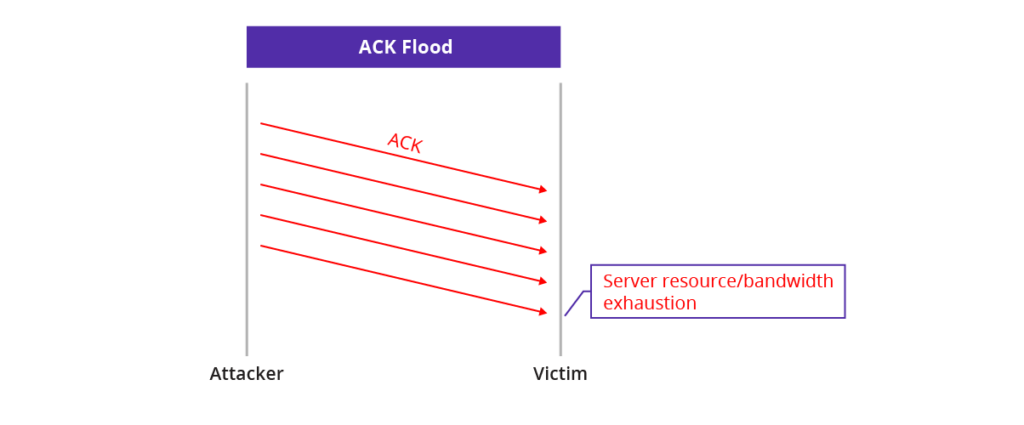
An ACK flood typically works by sending a high rate of TCP packets with the ACK flag set toward a target server or network device.
When a stateful firewall or server receives an ACK packet, it may check its connection or state table to determine whether the packet belongs to an existing TCP session.
During an ACK flood:
- The attacker generates large volumes of TCP ACK packets.
- The target receives ACK packets at an unusually high packets-per-second (PPS) rate.
- Stateful devices inspect the packets and check whether matching connection information exists.
- Invalid or unsolicited ACK packets are discarded.
- At sufficiently high traffic volumes, packet processing, CPU resources, or network bandwidth can become exhausted.
This can increase latency, cause packet loss, disrupt legitimate TCP connections, or make the protected service unavailable.
What Does an ACK Flood Target?
ACK floods can affect more than the origin server itself. Common targets include:
- Stateful firewalls
- Load balancers
- Servers
- Routers and network appliances
- Other devices that perform TCP connection-state validation
Because these devices may need to inspect incoming ACK packets and compare them against existing connection information, extremely high packet rates can create significant processing pressure.
ACK Flood vs. SYN Flood
ACK floods and SYN floods are both TCP-based Layer 4 DDoS attacks, but they target different parts of TCP communication.
| ACK Flood | SYN Flood | |
|---|---|---|
| TCP flag | ACK | SYN |
| Primary method | Sends large volumes of ACK packets | Sends large volumes of connection requests |
| TCP state | Often uses ACK packets unrelated to valid sessions | Creates large numbers of incomplete connections |
| Main impact | Packet processing and bandwidth exhaustion | Connection-state and resource exhaustion |
| Common defense | Stateful validation, filtering, DDoS mitigation | SYN cookies, SYN proxy, filtering, DDoS mitigation |
A SYN flood primarily abuses the TCP connection-establishment process, while an ACK flood attempts to overwhelm the infrastructure responsible for processing TCP ACK traffic.
How to Detect an ACK Flood Attack
Common indicators of an ACK flood include:
- A sudden increase in TCP ACK traffic
- Abnormally high packets-per-second rates
- Large numbers of ACK packets that do not match established TCP sessions
- Increased CPU utilization on firewalls or network devices
- Packet loss or increased network latency
- Legitimate TCP connections timing out
- Unexpected bandwidth saturation
Traffic baselining and real-time network monitoring can help identify abnormal ACK traffic before it significantly affects services.
How to Mitigate an ACK Flood Attack
Effective ACK flood mitigation typically combines several techniques.
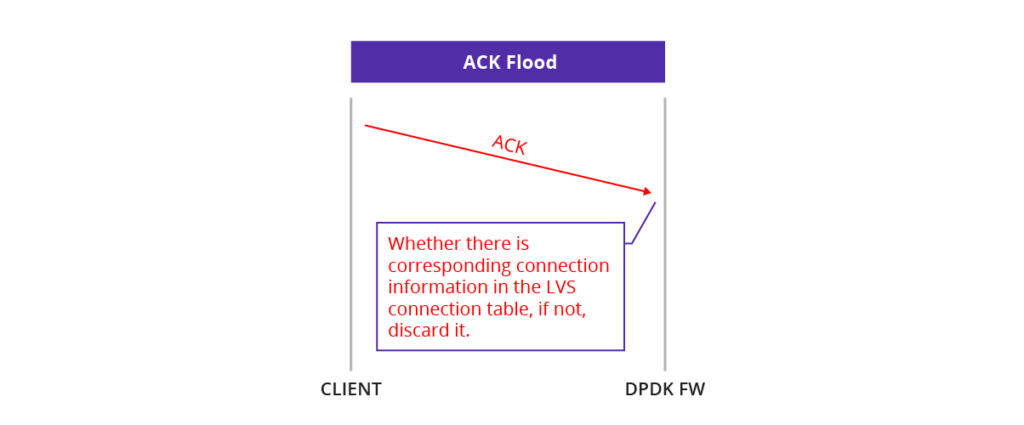
Stateful Connection Validation
Network devices can verify whether incoming ACK packets belong to established TCP connections. If no corresponding connection information exists in the connection table, the packet can be discarded.
Traffic Filtering
Invalid, malformed, spoofed, or out-of-state ACK packets can be filtered before they reach protected infrastructure.
Rate-Based Detection
Monitoring ACK packet rates makes it possible to identify abnormal traffic spikes and apply mitigation policies when traffic exceeds expected thresholds.
DDoS Traffic Scrubbing
Large-scale ACK floods may exceed the capacity of local firewalls or servers. DDoS scrubbing infrastructure can absorb attack traffic and filter malicious packets before forwarding legitimate traffic to the origin.
Distributed DDoS Protection
Globally distributed mitigation capacity helps prevent large ACK floods from overwhelming a single network location or origin infrastructure.
How CDNetworks Helps Protect Against ACK Flood Attacks
CDNetworks uses high-performance traffic inspection and DDoS mitigation technologies to identify and filter abnormal Layer 3 and Layer 4 traffic.
For ACK flood protection, the firewall can check whether an incoming ACK packet corresponds to information in the TCP connection table. If no valid connection exists, the packet can be discarded before it reaches the protected service.
Combined with large-scale traffic scrubbing and distributed DDoS mitigation infrastructure, this approach helps reduce the impact of high-volume ACK flood attacks while allowing legitimate TCP traffic to continue reaching the origin.
Learn more about CDNetworks Flood Shield 2.0 and how it helps protect applications and infrastructure against ACK floods and other DDoS attacks.
ACK Flood FAQ
Is an ACK flood a Layer 4 attack?
Yes. An ACK flood is a Layer 4 DDoS attack because it targets TCP, which operates at the Transport Layer of the OSI model.
What does ACK stand for?
ACK stands for acknowledgment. TCP uses ACK packets to confirm that transmitted data has been received successfully.
What is the difference between an ACK flood and a SYN flood?
A SYN flood targets the TCP connection-establishment process by generating large numbers of incomplete connections. An ACK flood sends large volumes of ACK packets to consume network bandwidth or packet-processing resources.
Is an ACK flood the same as a SYN-ACK flood?
No. An ACK flood primarily uses packets with the ACK flag set, while a SYN-ACK flood sends packets containing both SYN and ACK flags.
Can a firewall stop an ACK flood?
A stateful firewall can identify and discard ACK packets that do not belong to valid TCP connections. However, extremely large ACK floods can overwhelm the firewall or network capacity itself, making upstream DDoS mitigation necessary.