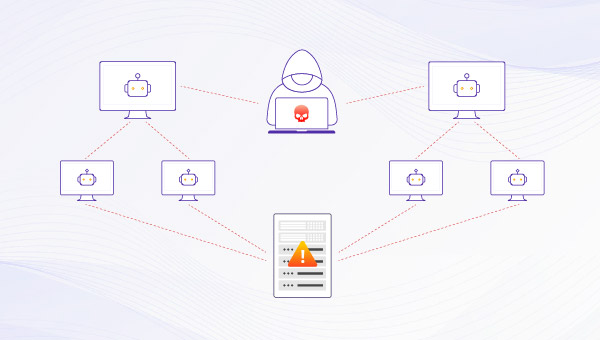
A DDoS attack works by coordinating traffic from multiple distributed sources to overwhelm a website, server, application, or network. Depending on the attack method, the traffic can saturate bandwidth, exhaust connection-handling resources, or overload an application with excessive requests.
To understand the basic concept first, read our guide on what a DDoS attack is. Below, we’ll focus on the technical process, the resources attackers target, and what happens during an attack.
How Does a DDoS Attack Work?
A DDoS attack works by coordinating traffic from many sources to overwhelm a single target. Attackers typically begin by assembling a network of compromised devices and directing them to send requests to the same service at the same time. Each device may generate only a small amount of traffic, but together they create a volume that targeted servers cannot process efficiently, leaving legitimate users unable to connect.
Once traffic reaches the target, different layers of the network stack are affected in different ways, from bandwidth saturation at the network layer to connection exhaustion at the transport layer and request handling strain at the application layer.
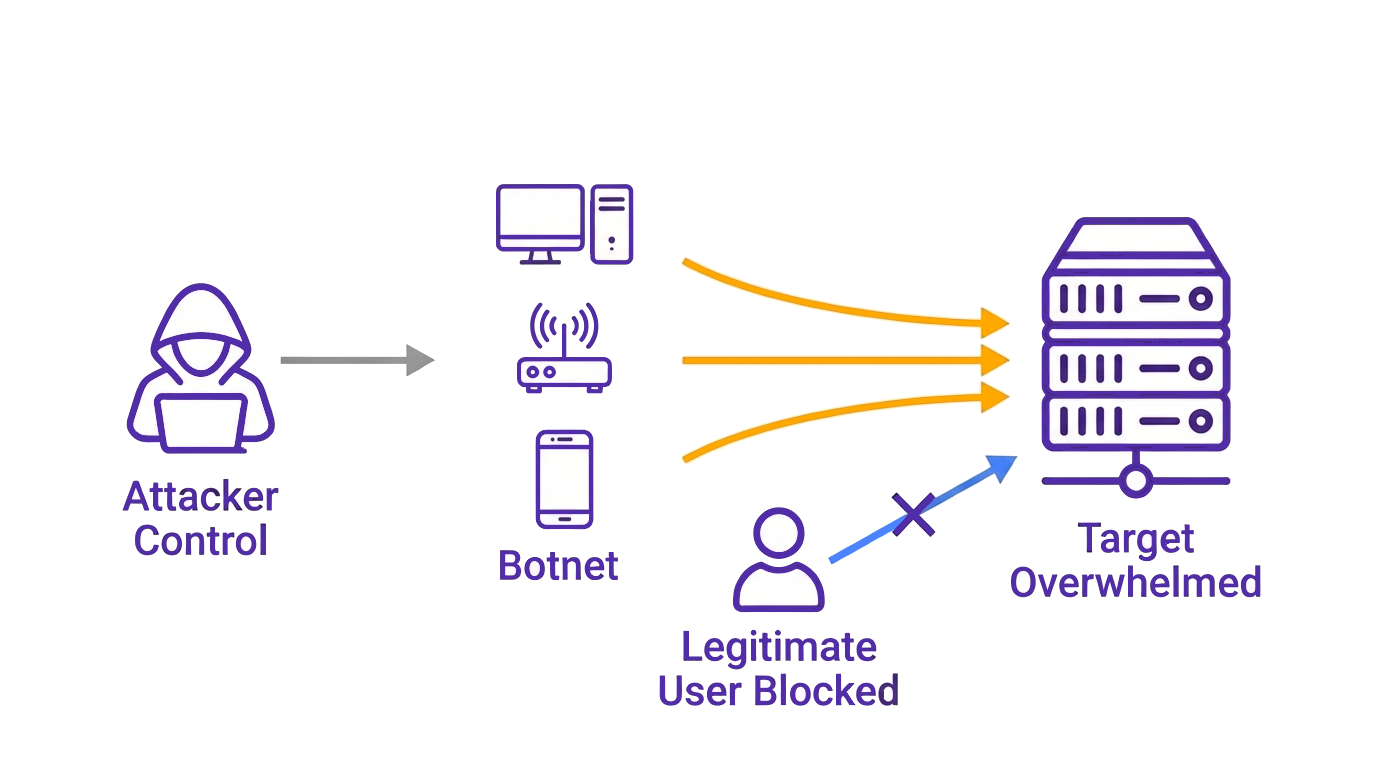
Some DDoS attacks rely on sheer traffic volume, such as volumetric attacks that flood bandwidth with amplified packets, often involving abuse of open DNS server responses to magnify traffic. Others focus on exhausting protocol resources through techniques like SYN floods and other protocol attacks. More advanced attacks operate at the application layer by repeatedly triggering actions such as page loads or API calls.
Attackers rarely rely on a single technique. Modern DDoS campaigns often shift methods during an active attack, as the attack includes multiple vectors that change based on defensive responses, adjusting traffic patterns, packet structures, or request rates to bypass static defenses.
Volume may spike suddenly, then drop into lower-rate flows designed to blend in with normal usage, making detection more difficult and prolonging disruption. Without visibility across layers and traffic sources, distinguishing malicious traffic from real users becomes increasingly challenging as the attack evolves.
Step 1: The attacker coordinates distributed sources
An attacker controls or coordinates distributed traffic sources, which may include compromised devices or systems used for reflection and amplification.
Step 2: Traffic is directed toward a target
These sources send coordinated packets, connection attempts, or application requests toward a selected IP address, domain, or service endpoint.
Step 3: Infrastructure resources become saturated
The impact depends on the attack vector. Large floods may saturate bandwidth, SYN floods may exhaust connection-handling capacity, and HTTP floods may consume application or backend resources.
Step 4: Legitimate users experience disruption
As available resources become constrained, genuine requests may be delayed, rejected, or timed out. The resulting symptoms can include high latency, connection failures, and service outages.
What Happens to a Server During Different DDoS Attacks?
| Attack Type | Targeted Resource | Typical Monitoring Signals |
|---|---|---|
| Volumetric | Network bandwidth | Bps, link utilization, and dropped traffic |
| Protocol | Packet processing or connection state | PPS, SYN backlog, and connection errors |
| Application Layer | Web and backend processing | RPS, HTTP errors, latency, and CPU utilization |
Different DDoS attack vectors produce different symptoms. Monitoring bandwidth alone may miss application-layer attacks, while request volume alone may not reveal connection-state exhaustion. Security teams need visibility across multiple layers to understand where the disruption occurs.
How Long Does a DDoS Attack Last?
The length of a DDoS attack varies widely because it reflects an ongoing contest between attackers and defenders rather than a fixed timeline. Once an attack begins, its duration depends on how quickly defensive controls can respond to shifting traffic patterns and attack techniques.
Some attacks last only a few minutes and are designed to test response thresholds or trigger a brief service of disruption. Others continue for hours or even days when attackers adapt their methods after initial defenses take effect, rotating sources or switching attack vectors to maintain pressure on the target.
Attack objectives also influence how long an attack persists. Short campaigns may aim to probe weaknesses or create temporary outages, while prolonged attacks often target sustained downtime, revenue loss, or reputational damage, especially for customer-facing services.
Defensive readiness plays a decisive role. When mitigation systems identify malicious traffic early and respond effectively, attacks lose impact quickly. In less prepared environments, attackers gain time to blend malicious traffic with legitimate users and extend disruption.
Over time, the cost of maintaining an attack rises, and once defenses force diminishing returns, many campaigns slow down or stop altogether. In practice, the duration of a DDoS attack often reveals more about a target’s resilience than the attacker’s initial scale.
How to Prevent a DDoS Attack?
Understanding how DDoS attacks work helps organizations identify which resources need protection.
Traffic monitoring, upstream filtering, rate controls, infrastructure redundancy, and application-layer defenses can reduce the impact of different attack vectors. For a detailed preparation checklist, read our guide on how to prevent a DDoS attack.
How Can CDNetworks Help Stop DDoS Attacks?
Once a DDoS attack is underway, the priority shifts from simply blocking traffic to keeping services accessible. Traffic surges may arrive from multiple vectors at once, while request patterns change rapidly as attackers probe for weaknesses. In these conditions, static defenses and on-premises capacity are often unable to respond quickly enough, especially when attacks target multiple layers of the network simultaneously.
For businesses under active attack, CDNetworks provides cloud-based DDoS mitigation through Flood Shield 2.0. Incoming traffic is routed through globally distributed Points of Presence (PoPs), where traffic is analyzed and filtered before it reaches the origin server.
Flood Shield 2.0 addresses modern DDoS attack scenarios through the following capabilities:
-
Protection Across All DDoS Attack Vectors
Flood Shield 2.0 mitigates volumetric, protocol, and Layer 7 DDoS attacks using layered, behavior-based controls at the network edge. -
20+ Tbps Global Scrubbing Capacity
Distributed scrubbing centers absorb large-scale traffic floods early, preventing bandwidth saturation and infrastructure overload. -
Adaptive, AI-Driven Defense
Real-time traffic profiling and machine learning continuously adjust mitigation policies as attack patterns evolve. -
Integrated WAAP Protection
DDoS mitigation operates alongside Web Application Firewall, bot management, and API security to protect application logic and exposed interfaces. -
Globally Distributed Infrastructure
A wide PoP footprint disperses attack traffic close to its source, reducing latency and avoiding single points of congestion. -
Cloud-Based, Always-On Operation
Continuous monitoring and automated response eliminate delays associated with manual activation or hardware-based defenses. -
24/7/365 Security Support
Dedicated security teams monitor attacks around the clock and assist throughout the detection and mitigation phases.
As modern DDoS attacks shift tactics in real time, effective defense depends on adaptive mitigation rather than static blocking. Maintaining availability under sustained pressure requires visibility across layers, distributed capacity, and the ability to respond dynamically as attack behavior changes.
DDoS Attacks FAQs
How do DDoS attacks work?
DDoS attacks work by coordinating large numbers of devices to send connection requests or HTTP requests toward targeted servers. Attack traffic may target bandwidth, network protocols, or application behavior to disrupt legitimate users’ access.
What happens during a live DDoS attack?
During a live DDoS attack, malicious traffic competes with legitimate traffic for network and server resources. As resources are exhausted, legitimate users experience slow responses or complete service disruption.
How long do DDoS attacks last?
DDoS attacks may last from a few minutes to several days. Duration depends on attacker objectives, attack complexity, and how quickly mitigation measures are activated.
Can a DDoS attack work without saturating bandwidth?
Yes. Application-layer DDoS attacks can exhaust web server threads, database connections, or other application resources through repeated requests without fully saturating the network connection. This is why detecting DDoS attacks requires application-level metrics as well as network traffic monitoring.