
Bot traffic is not always obvious.
Simple scripts may generate repetitive requests that are relatively easy to identify. More sophisticated bots can rotate IP addresses, execute JavaScript, use real or headless browsers, maintain cookies and sessions, and imitate normal user behavior.
Reliable bot detection therefore requires more than spotting a traffic spike or blocking a suspicious IP address. The process starts with identifying unusual activity in analytics, security events, and server logs, then combining network, device, browser, and behavioral signals to determine whether that activity is automated.
What Is Bot Traffic?
Bot traffic is website, application, or API activity generated by automated software rather than by a person manually performing every action.
Some traffic bots perform legitimate functions. Search engine crawlers discover and index content, monitoring services check website availability, and approved integrations automate business processes.
Other bots automate unwanted or malicious activities such as:
- Credential attacks
- Brute-force attempts
- Web scraping
- Fake registrations
- Spam
- Carding and payment fraud
- Inventory hoarding
- Scalping
- Click fraud
- Vulnerability scanning
Detecting automation is therefore only part of the challenge. Websites also need to determine whether a bot is legitimate, suspicious, or malicious.
How Can You Tell If Your Website Has Bot Traffic?
Analytics, security events, and server logs can reveal patterns that suggest automated activity.
These warning signs can help identify where further investigation is needed, but no individual anomaly proves that a bot is responsible.
1. Unexpected Spikes in Pageviews or Requests
A sudden increase in website traffic without a corresponding campaign, product launch, news event, or other legitimate explanation can indicate automated activity.
The pattern often matters as much as the overall volume.
Thousands of requests concentrated on login pages, pricing pages, search endpoints, inventory APIs, or a small number of product pages may be more suspicious than a broad increase in normal website traffic.
2. Unusual Traffic Sources or Locations
Unexpected concentrations of requests from particular IP ranges, networks, autonomous systems, hosting providers, or geographic regions can indicate automated activity.
Geography alone, however, is not reliable evidence of a bot.
Legitimate users may travel, use VPNs, connect through corporate networks, or access services through infrastructure located outside their physical region.
Network origin should therefore be evaluated alongside behavioral and technical signals.
3. Abnormal Session and Engagement Patterns
Bots often interact with websites differently from human users.
Potential indicators include:
- Extremely short or long sessions
- Highly repetitive session durations
- Very fast navigation between pages
- Predictable page sequences
- Little meaningful interaction
- Large volumes of identical behavior
An isolated unusual session is rarely meaningful. Repeated patterns that differ significantly from normal user behavior provide stronger evidence of automation.
4. Fake or Junk Conversions
Automated tools can submit forms, create accounts, subscribe to mailing lists, add products to carts, or trigger other events that appear to be conversions.
Warning signs can include:
- Nonsensical names or contact information
- Large numbers of similar registrations
- Sudden increases in form submissions without corresponding sales
- Repeated abandoned carts
- Unusual promotional-code usage
- High volumes of low-quality leads
These patterns may indicate spam, fake account creation, fraud, or automated testing.
5. Repeated Login Failures or Account Activity
Large numbers of login attempts across multiple accounts can indicate credential stuffing, where bots test previously compromised username and password combinations at scale.
Other suspicious patterns include:
- Rapid authentication attempts
- Attempts across many usernames
- Repeated password-reset requests
- Account enumeration
- Similar activity across multiple accounts
- Unusual post-login behavior
Successful automated login abuse can ultimately lead to account takeover, making authentication endpoints an important area to monitor.
6. Repetitive Requests to Valuable Pages or APIs
Bots often concentrate activity on resources with direct business value.
Common targets include:
- Product and pricing pages
- Search APIs
- Login endpoints
- Checkout flows
- Ticket or inventory pages
- Promotional pages
- Content archives
- Data-rich APIs
Systematic requests to these resources may indicate scraping, inventory monitoring, scalping, reconnaissance, or automated API abuse.
How to Detect Bot Traffic
Analytics anomalies can show where to investigate. Technical detection methods help determine what generated the traffic.
Reliable bot traffic detection usually combines several signals rather than relying on one rule.
1. Analyze Server Logs and Request Patterns
Server, CDN, WAF, application, and API logs provide detailed information about incoming requests.
Useful signals include:
- Request frequency
- Requested URLs and endpoints
- HTTP methods
- HTTP headers
- Response codes
- Request timing
- Session identifiers
- Geographic and network information
- Repeated navigation sequences
A client systematically requesting thousands of product pages may indicate scraping.
Rapid requests against authentication or checkout endpoints may indicate automated abuse.
Patterns across multiple requests, sessions, accounts, and endpoints are usually more informative than one isolated request.
2. Evaluate IP and Network Reputation
IP and network analysis can evaluate characteristics such as:
- IP reputation
- Data-center or hosting ranges
- Proxy and VPN usage
- Autonomous system information
- Geographic origin
- Previous malicious activity
- Request frequency
Known malicious infrastructure can sometimes be identified quickly using these signals.
However, sophisticated bots frequently use residential proxies, mobile networks, and rotating IP pools. A seemingly legitimate IP address therefore does not prove that the visitor is human.
IP intelligence works best as one layer of a broader detection strategy.
3. Use Device and Browser Fingerprinting
Device fingerprinting analyzes characteristics associated with the browser or device making a request.
Potential signals include:
- Browser configuration
- Operating system information
- Rendering characteristics
- JavaScript behavior
- Cookies
- Device attributes
- Browser capabilities
Fingerprinting can reveal inconsistencies between what a client claims to be and how it actually behaves.
For example, a client may identify itself as a normal browser through its User-Agent string while other attributes indicate an automation framework or unusual execution environment.
Fingerprinting can also help correlate activity when a bot repeatedly changes IP addresses.
4. Analyze User Behavior
Behavioral analysis examines how visitors interact with websites and applications.
Signals may include:
- Navigation order
- Time between actions
- Mouse movements
- Scrolling
- Click timing
- Typing patterns
- Transaction speed
- Repeated workflows
Human behavior naturally contains variation. Automated activity often produces more systematic patterns, even when bots deliberately add random delays or simulate human interactions.
Behavioral signals can therefore become particularly valuable when a bot’s network and browser characteristics appear legitimate.
5. Use TLS and Protocol Fingerprinting
TLS connections contain characteristics that can help identify the client software behind a request.
Different browsers, networking libraries, applications, and automation frameworks can generate different TLS handshake patterns. These characteristics can be compared with browser and request information to identify inconsistencies.
For example, HTTP headers may claim that a request came from a particular browser while its TLS characteristics resemble a different networking library.
Combining browser signals with TLS fingerprinting can make automated clients more difficult to disguise.
6. Apply Browser and Verification Challenges
When passive signals are inconclusive, websites can request additional evidence from a visitor.
Common approaches include:
- JavaScript challenges
- Cookie validation
- Browser fingerprint challenges
- CAPTCHA
A client that cannot execute expected browser behavior may be automated.
However, verification challenges are not definitive. Advanced bots can execute JavaScript, use real browser environments, and bypass some forms of CAPTCHA.
Challenges can also introduce friction for legitimate users, so they are generally most effective when applied according to risk.
7. Combine Signals With Machine Learning and Anomaly Detection
Modern bot detection systems increasingly evaluate multiple signals together rather than relying entirely on static rules.
Machine learning can combine network identity, request behavior, browser characteristics, device properties, session history, endpoint sensitivity, account activity, and threat intelligence.
Anomaly detection can then identify activity that deviates from established patterns or expected behavior.
One unusual signal may not provide enough evidence to classify a request as automated. Several related anomalies occurring together can provide much stronger evidence and reduce dependence on any single detection method.
Why Basic Bot Detection Methods Are Not Enough
Traditional detection and mitigation techniques still have value, but each has significant limitations when used alone.
IP Blocking
Blocking a malicious IP address can immediately stop requests from that source.
Sophisticated bots, however, can distribute requests through residential proxies, mobile networks, VPNs, and rotating IP pools. Blocking individual addresses becomes less effective when automated traffic originates from thousands of changing sources.
User-Agent Detection
Simple bots sometimes identify themselves through their User-Agent strings.
Malicious bots can modify this information and claim to be common browsers, search engine crawlers, or other legitimate clients.
User-Agent information can therefore contribute to classification but should not be treated as proof of identity.
Rate Limiting
Rate limiting restricts the number of requests a client can make within a defined period and can reduce high-volume automated abuse.
Sophisticated bots can evade static thresholds by lowering request frequency or distributing activity across many IP addresses, devices, accounts, or sessions.
CAPTCHA
Human-verification challenges can stop some automated clients, but advanced bots may use browser automation, solving services, or AI-assisted techniques to overcome them.
Frequent challenges can also create unnecessary friction for legitimate users.
Effective bot detection therefore depends on combining multiple technical and behavioral signals rather than assuming one method can identify every automated client.
How Do You Distinguish Good Bots From Bad Bots?
Detecting that a visitor is automated does not automatically mean the request should be blocked.
Search engine crawlers, monitoring tools, partner services, and approved business automation may provide legitimate value.
Malicious bot attacks can instead involve credential abuse, unauthorized scraping, fake account creation, payment fraud, inventory abuse, spam, or resource exhaustion.
Organizations can evaluate automated traffic according to:
- Identity
- Authorization
- Purpose
- Behavior
- Requested resources
- Request frequency
- Business impact
- Security risk
Known good bots should also be verified rather than trusted solely because they claim a familiar identity. Malicious automation can spoof User-Agent strings and other identifying information.
What Should You Do After Detecting Malicious Bot Traffic?
The appropriate response depends on the bot’s identity, behavior, and risk.
Possible actions include:
- Allowing verified legitimate bots
- Monitoring uncertain traffic
- Applying request limits
- Restricting access to sensitive resources
- Presenting browser or CAPTCHA challenges
- Requiring stronger authentication
- Blocking malicious requests
These actions form part of bot mitigation, but the correct response should vary according to the type and severity of automated activity.
A broader bot management strategy combines detection, classification, policy enforcement, monitoring, and mitigation while minimizing disruption to legitimate users and approved automated services.
How CDNetworks Helps Detect Malicious Bot Traffic
CDNetworks Bot Shield combines multiple detection and mitigation techniques to distinguish legitimate users and approved bots from malicious automation.
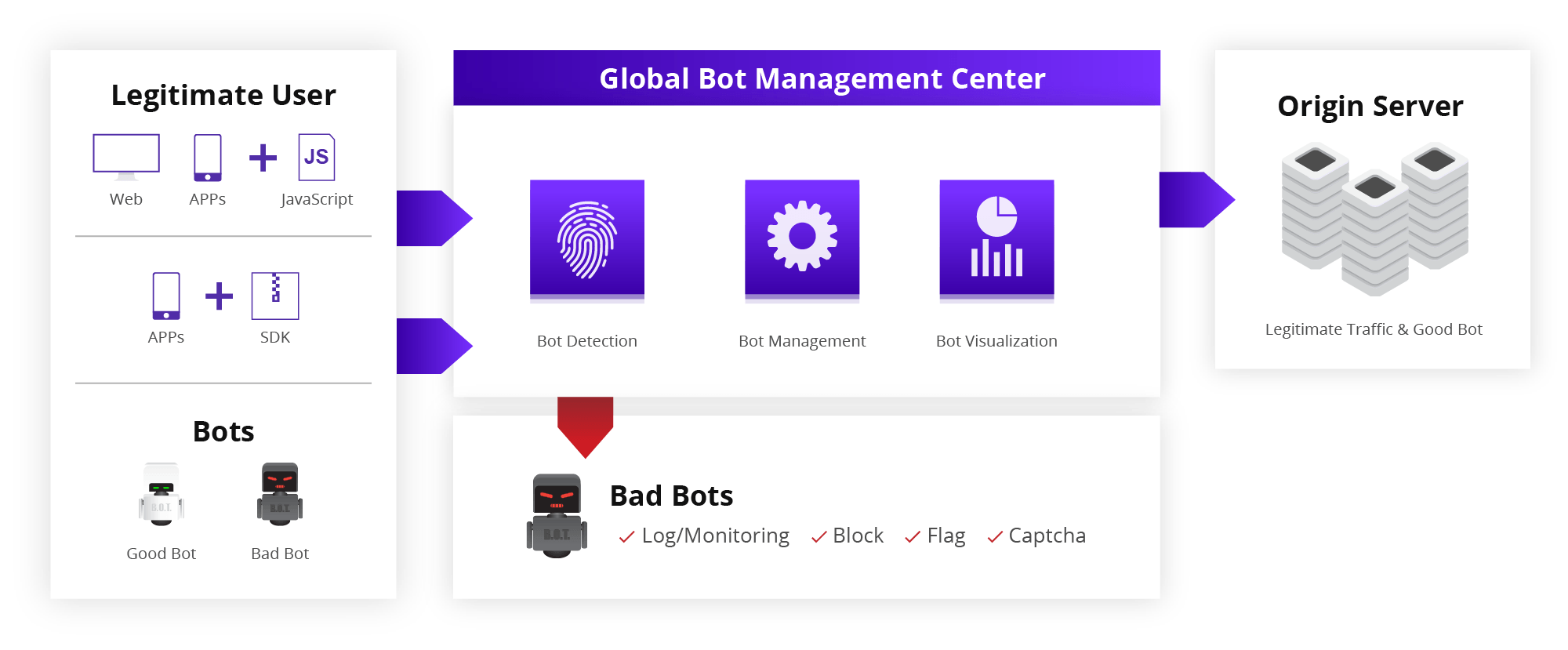
Its capabilities include:
- Good bot identification
- Advanced rate limiting
- Device and browser fingerprinting
- Human behavior detection
- CAPTCHA and fingerprint challenges
- Threat intelligence
- Machine learning
- Real-time monitoring and alerts
- Configurable mitigation actions
By evaluating multiple signals and applying different responses according to traffic risk, Bot Shield helps organizations protect websites, applications, APIs, accounts, and business processes from automated abuse.
Frequently Asked Questions
How can I tell if my website has bot traffic?
Traffic anomalies such as unexplained spikes, repetitive requests, abnormal sessions, fake conversions, failed logins, and unusual sources can indicate bots. Reliable confirmation requires network, device, browser, request, and behavioral analysis.
What is the best way to detect bot traffic?
Combining server logs, IP intelligence, fingerprinting, behavioral analysis, protocol signals, browser verification, threat intelligence, and anomaly detection provides stronger bot identification than relying on one technique.
Can Google Analytics detect bot traffic?
Analytics can reveal suspicious patterns in pageviews, sessions, engagement, geography, and conversions, but sophisticated bots usually require additional server-side, network, browser, device, or behavioral signals for reliable identification.
Can bots hide their IP addresses?
Bots can obscure or frequently change network identities through proxies, VPNs, residential networks, mobile networks, and rotating IP pools, reducing the effectiveness of IP-only detection.
Can bots imitate human behavior?
Bots can execute JavaScript, use real browsers, maintain sessions, introduce variable delays, and simulate interactions. Advanced detection evaluates those behaviors together with network, browser, device, and request signals.
What is the difference between bot detection and bot traffic detection?
Bot detection identifies and classifies automated clients broadly, while bot traffic detection applies those techniques specifically to automated requests reaching websites, applications, APIs, accounts, and online services.